Three months ago, I sat down on a Sunday afternoon with a cup of coffee and decided I was done avoiding my credit score. Not “done” in some dramatic, New Year’s resolution way — just done in the quiet, slightly tired way you decide to finally clean out a closet you’ve been ignoring for two years.
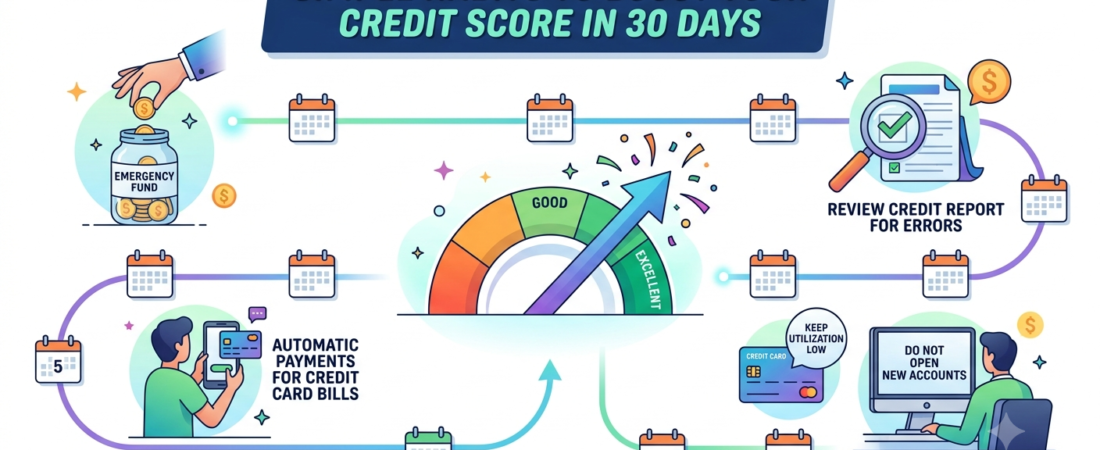
I won’t pretend I had some genius system. What I had was a list of five small, almost boring habits — things that took minutes, not hours. And 30 days later, when I checked my score again, it had moved more than I expected. Not because I did anything heroic. Because I stopped doing the things that were quietly working against me.
Here’s exactly what those five habits were, why they work, and — just as importantly — the emotional stuff that was actually getting in my way before I started.
What Actually Moves Your Credit Score in 30 Days (And What Doesn’t)
The fastest lever for your credit score is utilization — the percentage of your credit limit you’re using. Paying down balances before your statement closing date (not just the due date) can raise your score within one billing cycle, sometimes by 60-100 points if you were near your limit. Payment history and disputes take longer to reflect.
That’s the headline. Now let’s get into the actual habits — because knowing *that* utilization matters and actually *doing* something about it are two very different things.
Habit #1: Look at the Number — Even If It Scares You
This sounds almost too obvious to count as a “habit,” but it’s where everything else starts. For a long time, I didn’t check my score because some part of me believed checking it would somehow make it worse — the same fear I had to get over before I could do anything else on this list.
Here’s the thing: you can’t fix what you can’t see. Checking your score is a soft inquiry — it has zero impact on the number itself. The only thing avoiding it does is keep you working blind. Day one of your 30 days is just this: open a free app (Credit Karma, Experian, or your bank’s built-in tool) and look at the actual number, plus the breakdown of what’s affecting it.
Write that starting number down somewhere. You’ll want it for day 30.
Habit #2: Pay Down Your Balance Before the Statement Closes (Not the Due Date)
This was the single biggest lever for me, and it’s the one most people get wrong — not because they’re careless, but because nobody explains the distinction clearly.
Your credit card has two important dates each month: the statement closing date (when your balance gets “frozen” and reported to the credit bureaus) and the due date (when your payment is actually due, usually about three weeks later). Most people pay right around the due date — which means the higher balance from before you paid is what gets reported.
Here’s the real numbers from my situation: I had a card with a $2,000 limit and a balance that usually sat around $1,400 — about 70% utilization. My statement closed on the 18th of the month. I started making a payment on the 15th to bring that balance down to about $180 — 9% utilization — before the statement closed. Three weeks later, my score had jumped 38 points. Same income, same spending. Just different timing.
To find your statement closing date, check your last few statements or your card issuer’s app — it’s usually listed clearly near the balance summary.
Habit #3: Catch the “What-the-Hell” Moment Before It Becomes a Spiral
This habit isn’t really about a specific action — it’s about catching yourself mid-pattern. There’s a moment that happens right after you go over a spending limit you’d set for yourself, where your brain basically says “well, this month’s already blown, might as well.” That’s the exact spiral I wrote about here, and it’s responsible for more maxed-out cards than any single big purchase ever is.
For your 30 days, the habit is simple: set a balance alert at 50% of your limit (most banking apps let you do this in under a minute). When it hits, don’t panic and don’t spiral — just pause before the next non-essential purchase. That single pause, repeated a few times over a month, is often the difference between staying under 30% utilization and blowing past it.
Habit #4: Dispute the Errors You Didn’t Know Were There
About 1 in 5 consumers has an error on at least one of their credit reports — and these aren’t always small. A payment marked “late” that was actually on time, an account that isn’t yours, a collection that should have aged off years ago.
Pull your free reports at AnnualCreditReport.com (all three bureaus, free, no catch) and scan for anything that looks off. If you find something, each bureau has an online dispute process, and they’re required to investigate within 30 days. I found one old collections account on my report that should’ve dropped off two years earlier — disputing it took about 15 minutes, and it was removed three weeks later.
This won’t always move the needle in exactly 30 days, but when it works, it can be one of the bigger jumps on this list — and it costs nothing but a little time.
Habit #5: Ask for a Limit Increase — Without Spending the Difference
This one feels almost like a cheat code, but it’s completely legitimate: if you’ve had a card for at least six months with on-time payments, call (or use the app) to request a credit limit increase. Many issuers will do this without a hard inquiry.
Here’s why it works: utilization is balance ÷ limit. If your limit goes from $2,000 to $3,000 and your balance stays the same, your utilization ratio drops automatically — even if you don’t pay down a single dollar. The catch, obviously, is the second half of that sentence: don’t spend the new room you just created. The whole point is more breathing room on paper, not more spending power in practice.
If you don’t have a card eligible for a limit increase yet — or you’re building credit from scratch — a secured credit card or credit-builder loan can be a starting point that gets you into this system in the first place.
Who This 30-Day Plan Works Best For (and Who Needs a Different Approach)
This plan works well if:
- You already have at least one credit card or loan with some payment history
- Your balances are high relative to your limits, but you can pay some of it down
- Your score is in the “fair to good” range and you’re trying to push it higher
This plan needs adjusting if:
- You have no credit history at all — your first move is opening a starter account, not optimizing an existing one
- You’re dealing with collections or significant past-due accounts — that’s a longer-term rebuilding process, not a 30-day tweak
- Your balances are high because of an ongoing income shortfall — in that case, the budget side of things matters more right now than the credit side
The Honest Downsides Nobody Mentions
A few things worth knowing before you get your hopes up too high:
- Not every issuer reports the same way. Some report your balance on the statement date, others report whatever your balance happens to be on a specific day each month regardless of your statement cycle. If Habit #2 doesn’t move your score as expected, this timing mismatch is often why.
- Limit increase requests can sometimes trigger a hard inquiry depending on the issuer, even when they say they “usually” don’t. If you’re about to apply for a mortgage or major loan, it might be worth waiting on this one.
- Disputes don’t always resolve in your favor — if the information is accurate, it’ll stay, even after investigation.
- 30 days is a snapshot, not a guarantee. Some months, your score might barely move even if you did everything right — scoring models update on their own schedules, and other factors (like average account age) shift slowly no matter what you do.
Your Score Will Move — But It’s Still Not the Whole Story
After my 30 days, my score had gone up by a meaningful amount — enough to genuinely change what loan offers looked like for me. And I’d be lying if I said that didn’t feel good.
But I also want to be honest about something: even with that higher number, this number still isn’t the whole story — not about my finances, and definitely not about me as a person. It’s a tool. A useful one, worth paying attention to, worth improving. But it’s one input into a much bigger financial picture, not a grade on how well you’re doing in life.
If you start these five habits this week, give it the full 30 days before you check again. Some of these move fast. Some take the whole window. All of them are worth doing regardless of what the number says — because every single one of them is also just… good financial hygiene, on its own terms.
FAQ: Quick Answers Before You Start
Can my credit score really change in just 30 days?
Yes — utilization-based changes (Habits #2 and #5) can show up within one billing cycle, often 2-4 weeks. Dispute resolutions and payment history changes can take a bit longer but often still land within a similar window.
Do I need to do all five habits, or just one?
Even one or two can move the needle — Habit #2 (paying down before the statement date) tends to have the biggest single impact for most people. But they compound, so doing all five gives you the best shot at a noticeable jump.
What if my score doesn’t move at all after 30 days?
It happens, and it’s not necessarily a sign you did something wrong — scoring models weigh dozens of factors, and some (like average account age) shift very slowly regardless of your actions. Keep the habits going; the effect is often cumulative over 60-90 days.
Will checking my score every few days during this process hurt it?
No — checking your own score is always a soft inquiry, no matter how often you do it. Checking weekly during this 30-day window is a great way to stay motivated without any downside.
I don’t have a credit card — can I still do this?
Most of this plan assumes at least one existing account. If you’re starting from zero, your first 30 days look different — focused on opening a starter account (secured card or credit-builder loan) rather than optimizing utilization on something that doesn’t exist yet.