I was 22 when I got my first credit card. Nobody explained APR to me. Nobody told me that paying the minimum every month meant I’d be paying for that card for years. Nobody walked me through what a credit score was, why it mattered, or how fast it could drop.
I learned all of that the hard way — through mistakes that cost me real money and years of financial stress that could have been avoided with about four hours of decent education.
If that sounds familiar, I want to say something clearly before anything else: that’s not a personal failure. That’s a systemic one. And understanding the difference matters — not just emotionally, but practically — because “I’m bad with money” and “I was never taught this” require completely different responses.
The Numbers Are Worse Than You Think
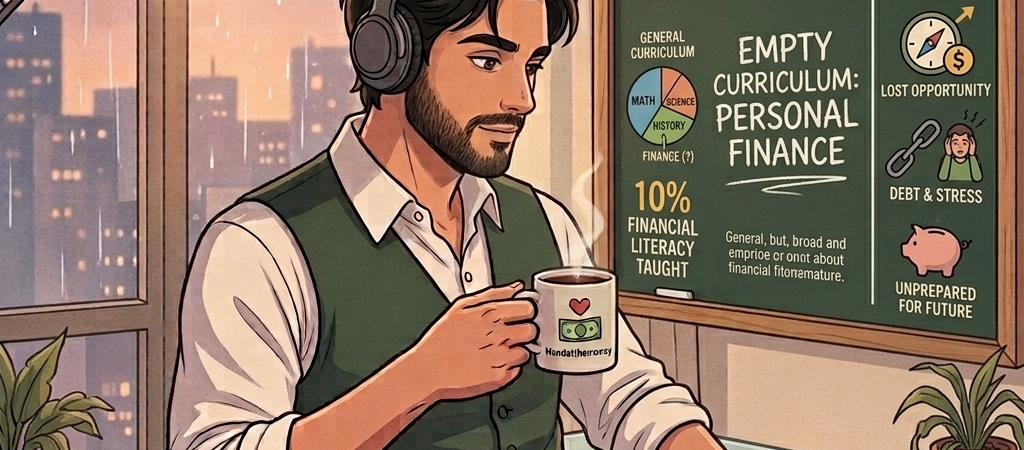
Only 25 U.S. states require a personal finance course in high school as of 2025. Two-thirds of states earned a C or lower for financial education quality. This isn’t an oversight — it’s the result of decades of curriculum priorities that consistently deprioritized money management skills, leaving most American adults to figure out finances through trial, error, and expensive mistakes.
The downstream effects are measurable. According to Ramsey Solutions’ Financial Literacy Crisis Report, 8 in 10 American adults say they would have made fewer money mistakes if they’d learned personal finance in school. Adults who did take a personal finance class are five times more likely to say they graduated feeling prepared to handle money in the real world. Five times.
That gap — between who got the education and who didn’t — isn’t random. It tends to fall along geographic and socioeconomic lines. Students in wealthier districts are more likely to have access to financial literacy programs, either through schools or through parents who already understand how money works. Students without that access graduate into the same complex financial world with significantly fewer tools.
Why Financial Education Got Left Out — And Who Benefits From That
The reasons schools don’t teach personal finance are partly mundane: curriculum decisions are made at the state level, standardized testing drives priorities, and there’s a shortage of teachers who feel qualified to teach it. Financial literacy isn’t on the ACT or SAT, so it doesn’t make the cut.
But there’s a less comfortable layer worth naming: a financially illiterate consumer is a more profitable consumer. Someone who doesn’t understand compound interest is more likely to carry a credit card balance. Someone who doesn’t understand loan terms is more likely to sign something they shouldn’t. Someone who doesn’t understand how marketing works is more likely to spend money that doesn’t improve their life.
This isn’t a conspiracy — it’s just an incentive structure. The financial industry spends billions on marketing and lobbying every year. Financial education, which would make consumers harder to profit from, has no equivalent lobbying budget.
None of that makes your situation easier. But it does mean that “why didn’t I know this?” has a real answer that has nothing to do with your intelligence or your character.
The Real Cost: What Happens When Nobody Teaches You
The financial cost is the obvious part — the interest paid on debt you didn’t understand, the savings that never happened because nobody explained how to start, the opportunities missed because the basics weren’t in place.
The less-talked-about cost is emotional. Seventy-four percent of American adults report feeling financial stress frequently or sometimes. A significant portion of that stress isn’t about the numbers themselves — it’s about the shame of not knowing things that feel like they should be obvious. “Everyone else seems to understand this. Why don’t I?”
That shame is worth addressing directly, because it’s one of the main things that keeps people stuck. The shame that comes from feeling financially behind isn’t a character flaw — it’s a completely predictable response to being handed adult financial responsibilities without adult financial education. And it tends to produce avoidance, which makes everything harder.
The exit from that pattern starts with the same reframe: this is a knowledge gap, not a character gap. Those are fixable in completely different ways.
What You Can Do Right Now (Without Going Back to School)
The good news is that the actual knowledge gap isn’t that large. Most of what you need to manage money competently comes down to a handful of concepts — compound interest, credit utilization, the difference between an asset and a liability, how to build a basic budget — that can be learned in hours, not years.
Here’s where to start, in order of impact:
- Understand where you actually stand. Before learning anything new, know your real numbers — what comes in, what goes out, what you owe. This single step, which most people avoid, gives you the foundation everything else builds on.
- Learn the vocabulary. A lot of financial anxiety comes from terms that sound more complicated than they are. APR, net worth, credit utilization, compound interest — these aren’t advanced concepts. They’re basic ones dressed in jargon. Once the vocabulary clicks, the rest follows faster than you’d expect.
- Pick one thing to fix first. Not everything. One thing. The highest-interest debt, or the absent emergency fund, or the budget that doesn’t exist yet. Trying to fix everything at once is how people end up fixing nothing.
The rest of this cluster covers each of those starting points in detail — not as abstract advice, but as practical steps for someone starting from exactly where you are.
FAQ
Is it too late to start learning about money if I’m already in my 30s or 40s?
No — and this question comes up constantly, which suggests a lot of people are asking it. The best financial decisions you can make are always the next ones, not the previous ones. Starting at 35 with a clear understanding of how money works beats starting at 22 and fumbling through it for a decade.
What’s the single most important financial concept to understand first?
Compound interest — specifically how it works against you on debt and for you on savings. Once you understand that the same mechanism that makes debt expensive is what makes savings grow, the logic behind almost every other financial decision becomes clearer.
My parents didn’t teach me about money either. Where does the cycle start?
Usually with whoever first had access to better information — which is increasingly you, right now, because the information is more accessible than it’s ever been. Breaking the cycle doesn’t require becoming a financial expert. It requires learning enough to make better decisions than the ones that were modeled for you.