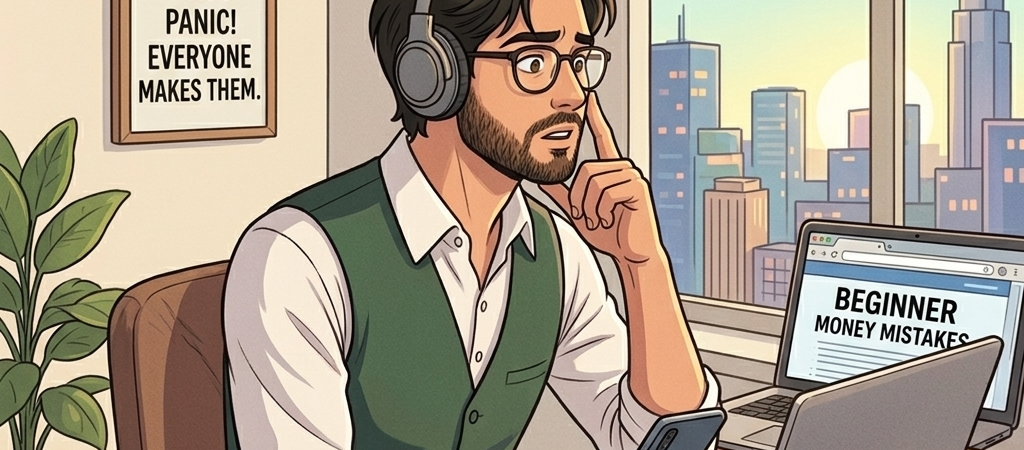
Six months into my first real job, I did the math on how much I’d paid in credit card interest and had to close my laptop for a minute. It wasn’t a catastrophic number in the grand scheme of things — but it was money that had simply evaporated because I paid the minimum and told myself I’d “catch up later.” Later never came. It just became normal.
I wasn’t reckless. I wasn’t bad with money in some dramatic way. I just didn’t have a reference point for what “normal” was supposed to look like — so I built my own definition out of whatever felt fine in the moment. Turns out, that’s almost everyone’s origin story.
What are the most common money mistakes beginners make?
The most common beginner money mistakes — no working budget, credit card minimums, no emergency fund, lifestyle inflation, and comparing yourself to others online — aren’t signs of poor discipline. They’re what happens to almost everyone without a financial reference model. The fix isn’t perfection; it’s noticing the pattern early and interrupting it once.
Why these mistakes are predictable, not personal failures
Here’s the part almost nobody says out loud: these mistakes aren’t rare exceptions committed by careless people. They’re the statistical default for anyone handed income, credit, and independence without a manual. You weren’t given a financial reference model growing up — most people weren’t — so you built your own out of trial, error, and whatever felt fine at the time. That’s not a character flaw. That’s just what happens in the absence of a model.
The shame that shows up when you notice you’ve made three or four of these mistakes at once is doing you a disservice. It doesn’t undo the mistake. It just makes you less likely to look closely enough to fix it.

If you’re earlier in this process — say, you just got your first paycheck and haven’t made any of these mistakes yet — the goal isn’t to avoid every single one perfectly. It’s to recognize the pattern faster than most people do.
The one root cause behind most of these mistakes
Look closely at any list of “beginner money mistakes” and you’ll notice they all trace back to the same root: nobody handed you a working model for what normal financial behavior actually looks like. Not a lack of intelligence. Not a lack of discipline. Just an absence of reference points — so you copy whatever’s closest, whether that’s a parent’s habits from a different economic era, a friend’s spending, or an influencer’s curated version of “having it together.”
The 5 mistakes almost everyone makes first
1. A budget you wrote once and never opened again
Here’s what this actually looks like: you download a budgeting app, spend 40 minutes categorizing your expenses on a Sunday afternoon, feel genuinely accomplished — and then never open the app again for three months. It’s not that the budget was wrong. It’s that a budget you don’t check isn’t a budget. It’s a document.
Say your budget assumed $400 a month for groceries and dining out. By month two, delivery apps and a few “just this once” dinners have quietly pushed that to $650 — a $250 monthly gap you have no way of noticing without a five-minute check-in. Over a year, that’s $3,000 draining out through a hole you never patched, simply because nobody told you a budget is a weekly habit, not a one-time document.
Do this now: pick one recurring day — Sunday night, payday, whatever fits — and set a 5-minute recurring phone reminder to open your budget or banking app and just look. Not adjust. Not judge. Just look. That single habit prevents more damage than the most detailed budget spreadsheet you’ll never revisit.
2. Paying credit card minimums and calling it “manageable”
Average credit card APRs have hovered around 24% in 2026. Here’s what that actually costs: carry a $3,000 balance and pay only the minimum (typically 2-3% of the balance), and you could spend over 10 years paying it off — and pay more in interest than the original balance itself. A $3,000 purchase can quietly become a $6,000+ purchase, spread out so slowly you never feel the full weight of it at once.
This is the single most expensive mistake on this list, dollar for dollar, precisely because it doesn’t feel expensive in the moment. The minimum payment is designed to feel manageable. That’s the entire business model.
Do this now: log into your card issuer’s site and look for the “payoff calculator” — nearly every major card (Chase, Capital One, Discover, Amex) has one built into the online portal. Enter your actual balance and see the real payoff timeline at minimum payments versus paying even $50 more per month. Seeing the actual number is usually what breaks the “it’s fine for now” story.
3. Skipping the emergency fund because “nothing’s happened yet”
Only about 28% of Americans have enough savings to cover three months of expenses. Skipping the emergency fund doesn’t feel like a mistake in the moment — nothing bad has happened yet, so it’s invisible. But nothing happening yet isn’t the same as nothing happening ever. A single $600 car repair or a missed paycheck from a delayed start date can turn into credit card debt at 24% APR, simply because there was no cash buffer to absorb the shock.
Do this now: open a separate savings account today — even at your existing bank — and move $25 into it before you do anything else with this paycheck. The amount matters far less than the habit of a dedicated account existing at all.
4. Lifestyle inflation the moment income increases
A raise or a new job creates real, almost physical pressure to upgrade everything at once — the apartment, the wardrobe, the takeout habit — to match a new sense of “having made it.” Concretely: a $500/month raise often turns into a $300 nicer apartment, a $100 new phone plan, and $100 more in weekend spending — all within the first two months, leaving the same $0 left over as before the raise, just at a higher lifestyle tier.
Do this now: before your next raise even hits your account, decide in advance what percentage goes to savings automatically (even 50% of the increase) and let yourself spend the rest guilt-free. Deciding before the money arrives is the entire trick — deciding after, once it’s already in checking, is far harder.
5. Treating investment tips you don’t understand as instructions
If you can’t explain why an investment might lose money and under what conditions you’d sell it, you don’t have an investment strategy — you have a rumor you’re following. Someone mentions a stock at a party, or you see a ticker trending online, and you buy $200 worth on impulse without ever reading what the company does. That’s not investing. That’s paying $200 to feel like you did something.
Do this now: before buying anything you heard about secondhand, write one sentence explaining what the company or fund actually does and why it might go up. If you can’t write that sentence, that’s your answer — wait until you can.
The mistake hiding inside all the others: comparing yourself to a highlight reel
Social comparison rarely shows up on these lists as its own category — usually it’s buried as a footnote under “impulse spending.” But it’s often the actual trigger behind lifestyle inflation and impulse purchases, not just one item on the list alongside them. Watching curated versions of other people’s financial lives online creates a benchmark that was never real to begin with, and then measures your very real, very normal beginning against it.
The math rarely gets said out loud: someone posting a new car or a vacation online is showing you one frame of their financial life, not the balance sheet behind it — the debt, the family help, the timeline. Comparing your first year of independence to their curated highlight reel isn’t just discouraging. It’s comparing two things that were never measuring the same thing.
The fix isn’t quitting social media. It’s naming the mechanism clearly enough that you stop mistaking someone’s highlight reel for their actual bank statement — and redirecting that energy toward picking a budgeting method that survives real life, instead of a lifestyle that only survives Instagram.
Frequently asked questions
Is it normal to have made several of these mistakes at once?
Yes — it’s closer to the norm than the exception. Most people don’t make one mistake in isolation; they stack two or three simultaneously during their first few years of financial independence.
How do I know which mistake to fix first?
Start with whichever one is actively costing you money right now — usually credit card interest — before addressing habits that are merely inefficient, like an unchecked budget.
Does making these mistakes early hurt my long-term financial future?
Not if you correct course within the first few years. The mistakes that cause lasting damage are the ones left unexamined for a decade, not the ones made and corrected early.
What if I’ve made all five of these mistakes at the same time?
Pick one — the one costing you the most money right now — and fix only that one this month. Trying to overhaul all five simultaneously is how most people abandon the whole effort within two weeks.
None of this is about becoming someone who never makes a mistake with money. It’s about shortening the distance between making one and noticing it.