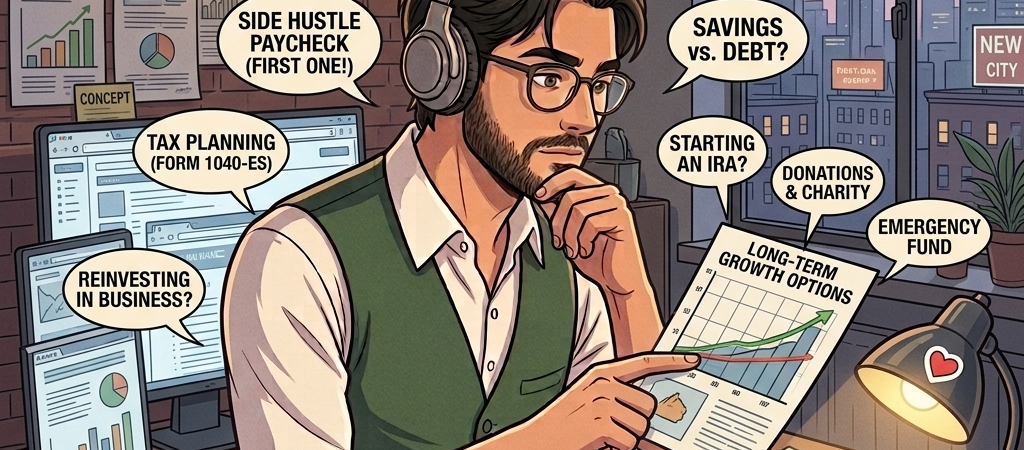
The first time a side hustle payment landed in my account, it felt different from my regular paycheck in a way I didn’t expect. Same dollar sign, same bank app — but somehow my brain filed it under “bonus money” instead of “actual income.” Within a week, most of it had quietly turned into takeout and a pair of shoes I’d been eyeing. I hadn’t decided to spend it. It just felt like money that didn’t count the same way.
That feeling isn’t random, and it isn’t a personal failing. It’s a well-documented pattern — and understanding it is the whole difference between a side hustle that actually moves the needle and one that just becomes extra spending money with a fancier name.
What should I do with my first side hustle paycheck?
The best use of side hustle income depends on your situation, but the priority order is: pay off high-interest debt first, then build a starter emergency fund, then put money toward a specific goal, and only then invest the rest. Deciding this before the money arrives works better than deciding after.
Quick takeaways before you decide anything
- Side hustle money gets spent faster than regular income because your brain treats it as a “bonus,” not real money.
- Most side hustlers don’t save any of it — deciding a destination in advance is what breaks that pattern.
- The priority order (debt → emergency fund → goal → invest) matters more than the specific amount.
- Automating the split removes the need to decide every single time the money arrives.
Why “extra” money disappears faster than your regular paycheck
This isn’t just a feeling — it’s a documented behavior pattern called mental accounting: money gets mentally sorted into different “buckets” depending on where it came from, and money labeled as a windfall or bonus gets spent more freely than money labeled as a regular paycheck, even though a dollar is a dollar either way. Side hustle income lands squarely in the “bonus” bucket in most people’s minds, which is exactly why it evaporates into small, forgettable purchases instead of building toward anything.

If your first paycheck from a regular job felt disorienting because the number was smaller than expected, side hustle income creates almost the opposite trap — it feels like free money precisely because no bills were riding on it before it arrived.
The number that explains why most side hustlers save nothing
Roughly only 28% of side hustlers report saving any part of what they earn, with the rest largely spending it on discretionary purchases. That’s not a willpower problem spread across three-quarters of side hustlers — it’s the predictable result of money arriving with no destination already assigned to it. Without a plan decided in advance, the default destination for unclaimed money is always the path of least resistance: whatever feels good in the moment.
Where the money should actually go, in order
| Priority | Where the money goes | Why it comes at this stage |
|---|---|---|
| 1 | High-interest debt (credit cards, typically 20%+ APR) | No investment or savings account reliably outpaces this interest rate |
| 2 | Starter emergency fund | Prevents the next surprise expense from becoming new debt |
| 3 | One specific goal (named, not vague) | A named goal (“$2,000 for a car repair fund”) resists impulse spending better than “savings” in general |
| 4 | Investing the rest | Only makes sense once the above are stable — otherwise you’re investing money you’ll need to pull out early |
What this actually looks like with real numbers
Say your side hustle brings in $300 a month, and you’re carrying $1,200 in credit card debt at 24% APR. Here’s how the priority order plays out in practice:
- Months 1-4: The full $300/month goes to the credit card. At this rate, the $1,200 balance clears in exactly four months — and you avoid roughly $120-150 in interest you’d otherwise pay by only making minimum payments over that stretch.
- Months 5-7: With the debt gone, that same $300/month now goes to a starter emergency fund. Three months in, you’ve got $900 set aside — most of the way to a $1,000 starter cushion.
- Month 8 onward: Once the starter fund is in place, you can start splitting the $300 — say $150 toward a named goal (a car repair fund, a security deposit for a new apartment) and $150 toward investing, or adjust the ratio based on what feels most urgent.
Notice what didn’t change through any of this: the amount coming in stayed the same ($300/month). What changed was having a destination decided in advance for each phase, instead of re-deciding what to do with it every single time it landed.
If you haven’t started this yet, building your starter emergency fund is usually the second stop for side hustle income, right after any high-interest debt is handled.
Give the money a destination before it arrives
The single most effective fix for the “bonus money” trap isn’t willpower — it’s deciding the split in advance, before the payment even lands. A few ways to do this concretely:
- Set up a separate account just for side hustle income, so it never mixes with your regular checking account and starts feeling like general spending money.
- Decide the percentage split ahead of time — for example, 50% to your current priority, 50% to a guilt-free spending category — so there’s no decision to make (and no willpower to test) every time money comes in.
- Automate the transfer the same day the payment clears, before it has time to sit in checking and start feeling spendable.
One more thing worth planning for before you spend any of it: the tax surprise that catches most side hustlers off guard, since side hustle income isn’t taxed the same way your regular paycheck is — setting aside a portion for taxes should happen before the rest gets divided up.
Frequently asked questions
Should I treat side hustle income differently if it’s inconsistent month to month?
Yes — base your plan on your lowest realistic month rather than your best one, and treat anything above that as extra progress rather than a baseline you can count on.
Is it okay to spend any of it without guilt?
Yes, and building in a small guilt-free portion (even 10-20%) actually makes the system more sustainable, since a plan with zero enjoyment tends to get abandoned within a few months.
What if my side hustle isn’t making much money yet?
The same priority order still applies at any amount — even splitting $50 a month according to this framework builds the habit before the amounts get larger.
The side hustle itself is the easy part to explain. What you do with the money in the first thirty seconds after it lands is what actually decides whether the extra effort was worth it.