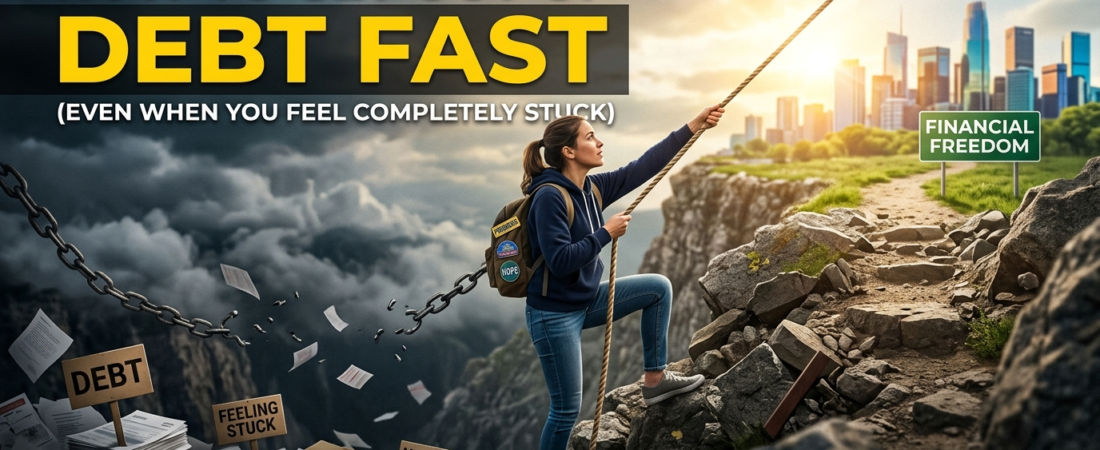
I remember staring at my credit card statement thinking, how did it get this bad? It didn’t happen overnight. It never does. It was the car repair I put on the card “just this once.” The medical bill I ignored for six months. The groceries I charged because payday was still four days away. One day I added it all up and the number staring back at me was $14,000. I closed the laptop and went to watch TV instead.
That’s the thing nobody talks about with debt: the first reaction isn’t action. It’s avoidance. And avoidance is exactly what makes it worse.
If you’ve opened this page, you’re already doing better than I was. You’re looking at the problem instead of away from it. That matters. Now let’s figure out how to actually fix it.
How to Get Out of Debt Fast: The Method That Actually Works
To get out of debt fast, follow these steps: list every debt with its balance and interest rate, stop adding new debt immediately, build a small $500 emergency buffer, then attack your debts using either the snowball method (smallest balance first) or avalanche method (highest interest first). Redirect every extra dollar — windfalls, side income, spending cuts — toward your target debt until it’s gone, then roll that payment into the next one.
Step 1: Face the Number (Even If It Scares You)
Most people in debt have a vague sense of how much they owe. A rough number floats around in their head — usually optimistic. The actual number, written down with every account, every balance, every interest rate, is almost always worse than the estimate. And that’s exactly why you need to see it.
Avoidance keeps debt invisible. Invisible debt grows unchecked. The moment you put it all on paper — or a spreadsheet, or the Notes app on your phone — it stops being a shapeless anxiety and becomes a problem with a size. Solvable problems have sizes. Anxieties don’t.
Here’s what to list for every debt you carry:
- The lender name
- The current balance
- The interest rate (APR)
- The minimum monthly payment
- The due date
That’s your debt inventory. It might be uncomfortable to build. Build it anyway. According to Experian, the average American was carrying a monthly debt payment of $1,237 in 2025. You are not alone in this — but the only way out starts with knowing exactly what you’re dealing with.
Step 2: Stop the Bleeding Before You Start Paying
Here’s the mistake I made the first time I tried to get out of debt: I made an aggressive payment on my credit card on a Tuesday and put $200 worth of groceries and gas back on it by Friday. I was running on a treadmill set to a speed I couldn’t sustain.
Before you throw a single extra dollar at debt, you need to stop adding to it. That doesn’t mean you have to cut up every card dramatically. It means being honest about why new charges keep appearing — and fixing that root cause first.
Ask yourself: Why am I still going into debt each month? Is your income genuinely not covering your expenses? Is it impulse spending? A subscription graveyard? Eating out because you’re exhausted and there’s nothing in the fridge?
The answer tells you where to intervene. You can’t bail out a boat that still has a hole in it.
Step 3: Build a $500 Buffer First (Yes, Before Paying Extra)
This sounds counterintuitive. If you’re in debt, why would you save money instead of throwing everything at the balance?
Once your buffer is in place, it’s time to pick a payoff strategy. There are two that actually work:
The Debt Snowball
Because without a small emergency buffer, every unexpected expense — a flat tire, a copay, a broken phone — goes right back onto the card. You make progress, life happens, you slide back. The cycle repeats. The $500 buffer isn’t savings in the traditional sense. It’s a firewall that protects your debt payoff plan from reality.
Step 4: Choose Your Weapon — Snowball or Avalanche
Once you have that buffer sitting in a separate account, you can attack your debt without constantly being derailed. And if you want to know where to keep that buffer while it earns something instead of nothing, learning how to start building your emergency fund the right way is a smart next step.
Pay minimums on everything. Throw every extra dollar at your smallest balance first, regardless of interest rate. When it’s gone, roll that payment into the next smallest. Repeat.
The math isn’t optimal. The psychology is. Paying off a $400 medical bill in two months gives you a real win — and real wins build momentum. Research consistently shows that people who feel progress are more likely to keep going. If you’ve tried the “logical” approach and quit, try this one instead.
The Debt Avalanche
Pay minimums on everything. Throw every extra dollar at your highest interest rate debt first. When it’s gone, move to the next highest. Repeat.
This method saves the most money over time. If you have a 29% APR credit card sitting next to a 6% personal loan, the avalanche approach could save you hundreds — sometimes thousands — in interest. The tradeoff is that it can take longer to see your first win, which is why it requires stronger motivation to stick with.
Which one should you choose?
If you’ve struggled with consistency and motivation: snowball. If you’re disciplined and the interest charges are genuinely large: avalanche. Either method beats the alternative, which is paying minimums forever and watching interest eat your progress alive.
Step 5: Find the Money You Didn’t Know You Had
You can’t speed up debt payoff without extra money going toward it. That money has to come from somewhere — either you spend less, earn more, or both. Let’s be specific about what that actually looks like in real dollars.
On the spending side:
- Canceling three unused subscriptions: ~$45/month
- Cooking at home five days instead of three: ~$150–$200/month
- Pausing one streaming service: ~$15–$18/month
- Negotiating your internet or phone bill: ~$20–$40/month
That’s potentially $230–$300/month found without a dramatic lifestyle overhaul. Over a year, that’s nearly $3,600 in extra debt payments.
On the income side:
- Selling items on Facebook Marketplace or eBay — most households have $200–$500 in unused stuff
- Picking up weekend gig work (DoorDash, Instacart, TaskRabbit)
- Freelancing a skill you already have — writing, design, bookkeeping, tutoring
- Directing your entire tax refund at your target debt (the average US refund in 2024 was over $3,000)
The goal isn’t to find one giant source of money. It’s to find several small ones and stack them.
Step 6: Automate Everything So Willpower Isn’t Required
Here’s what behavioral finance has taught us clearly: willpower is a finite resource. It depletes. The people who succeed at paying off debt aren’t more disciplined than you — they’ve built systems that make the right behavior automatic and the wrong behavior inconvenient.
Practical automations that work:
- Auto-pay minimums on every account — eliminates late fees and credit score damage
- Schedule your extra debt payment for payday — the money goes to debt before you can spend it on something else
- Move your $500 buffer to a separate bank — out of sight, out of reach for impulse use
- Set a monthly calendar reminder to check balances — keeps the goal visible without being obsessive
The moment money hits your checking account and sits there, it becomes vulnerable to every small decision you’ll make that day. Automation removes those decisions entirely.
The Mistakes That Keep People in Debt Longer
Most debt payoff articles tell you what to do. Fewer tell you what quietly sabotages the people who are trying. Here’s what actually derails people:
Paying the wrong debt first
Emotionally, we want to pay off the debt that stresses us out most — often a large balance that won’t move for years. Without a strategy, this produces no visible wins, kills motivation, and leads to quitting.
Closing credit cards immediately after paying them off
It feels good. It can also drop your credit score by reducing your available credit and shortening your credit history. If you can’t trust yourself with an open card, lock it in a drawer — don’t necessarily close it. Talk to a credit counselor before making that call.
Using debt consolidation as a shortcut without changing behavior
Rolling everything into a personal loan or balance transfer card can lower your interest rate — which is genuinely useful. But if the spending habits that created the debt don’t change, you’ll have a new loan and the old credit card balances rebuilt within 18 months. Consolidation is a tool, not a solution.
Setting a payoff timeline that requires perfection
Aggressive plans feel motivating on day one. By month three, one bad month blows up the whole schedule and people give up entirely. Build in a buffer — assume something will go wrong and plan for it.
When DIY Isn’t Enough: How to Know You Need Professional Help
There’s no shame in reaching the edge of what you can manage alone. In fact, recognizing that edge is one of the smarter financial moves you can make.
Consider reaching out to a nonprofit credit counselor if:
- Your minimum payments are consuming more than 20% of your take-home pay
- You’re being contacted by debt collectors
- You’ve missed payments on multiple accounts
- You’ve tried to pay down debt before and the balance keeps growing despite your efforts
The National Foundation for Credit Counseling (NFCC) connects Americans with certified, nonprofit credit counselors who can negotiate with creditors, set up debt management plans, and help you understand options like bankruptcy — without selling you anything. Many sessions are free or low-cost.
If someone is offering to “settle your debt for pennies on the dollar” in a radio ad, that’s not the same thing. Stick with NFCC-affiliated organizations.
FAQ: Getting Out of Debt Fast
How long does it realistically take to get out of debt?
It depends on the total amount, your interest rates, and how much extra you can apply each month. Someone with $8,000 in credit card debt applying an extra $300/month could be debt-free in under three years — faster with windfalls like tax refunds or bonuses. There’s no universal timeline, but most people underestimate how much momentum builds once the first debt is gone.
Should I pay off debt or save money first?
Both, in the right order. Build a $500 emergency buffer first. Then focus on high-interest debt aggressively. Once the high-interest debt is gone, build a full emergency fund. Trying to save seriously while carrying 25% APR credit card debt is mathematically counterproductive.
Does paying off debt hurt your credit score?
Paying off debt generally helps your score over time by reducing your credit utilization ratio. Closing accounts can temporarily lower it. Make payments on time throughout the process — that’s the single biggest factor in your score.
What if I can’t even afford the minimum payments?
Contact your creditors directly — many have hardship programs that temporarily reduce or pause payments. Then contact an NFCC-affiliated credit counselor. This is not a situation where waiting helps; it only adds late fees and collection activity.
Is debt consolidation a good idea?
It can be — if it lowers your interest rate and you close the loop on the spending behavior that created the debt. Used as a true reset with new habits, it works. Used as a way to “start fresh” without behavioral change, it usually doubles the problem within two years.