I remember the exact moment I checked my credit score and felt that specific kind of shame that only a three-digit number can produce. It was 581. Not catastrophic. Not hopeful either. Just… stuck. I had a job, I paid my bills — mostly on time — and I genuinely had no idea why the number wouldn’t move.
The frustrating part wasn’t the score itself. It was that I’d read every article about fixing it, and they all said the same things: pay on time, don’t max out your cards, dispute errors. Great advice. Also completely useless without knowing when to do it, why most people still fail even when they know the rules, and what invisible habits are quietly sabotaging progress.
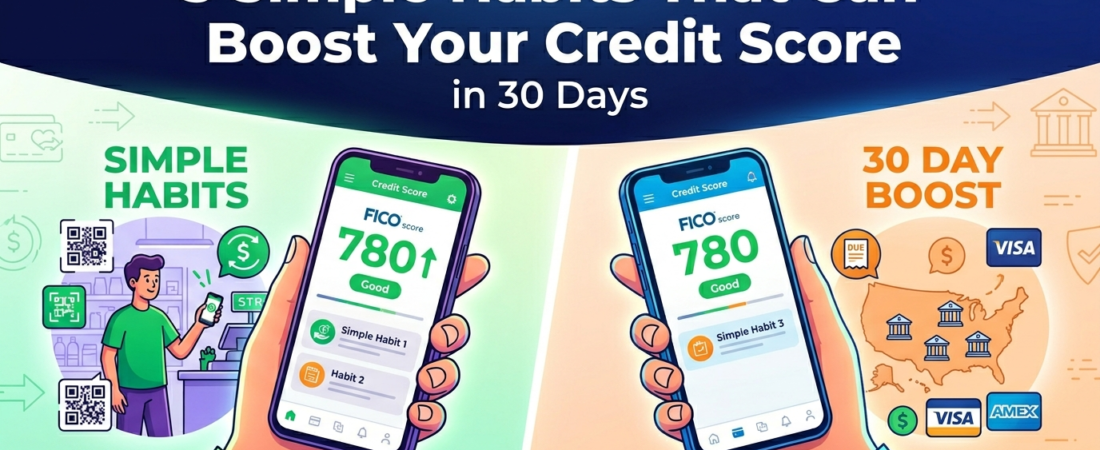
That’s what this article is actually about. Not just the five habits — but the psychology and timing that make them work in 30 days instead of 30 months.
Can You Really Boost Your Credit Score in 30 Days?
Yes — but with one honest caveat. You can boost your credit score in 30 days by reducing your credit utilization, disputing errors, and making on-time payments — but timing and psychology matter more than most guides admit. The five habits in this article are ordered by speed of impact, not difficulty, so you can start seeing results within a single billing cycle. How much your score moves depends entirely on where you’re starting from and which factors are weighing it down most.
Here’s what FICO actually measures, and roughly how much each piece matters:
- Payment history: 35% of your score
- Credit utilization: 30%
- Length of credit history: 15%
- Credit mix: 10%
- New inquiries: 10%
The first two factors — payment history and utilization — make up 65% of your score. That’s where your 30 days should be spent. The rest is mostly a long game.
Why Most People Know What to Do — and Still Don’t Do It
Here’s something no credit repair article will tell you: the problem usually isn’t information. It’s behavior.
Most Americans with low credit scores know they should pay on time and keep balances low. The issue is that credit improvement feels abstract and delayed. You make a good decision today and see zero feedback for 30 to 45 days. Human brains are terrible at staying motivated when there’s no immediate reward — and credit bureaus don’t exactly send you a “great job!” notification when you pay early.
What actually works is treating your credit score like a fitness goal with a 30-day deadline. The deadline creates urgency. Ordering the habits by speed of impact creates early wins. Early wins create momentum. Momentum creates the kind of consistency that turns a 581 into a 640 — and eventually, a 740.
So before we get into the five habits, accept this: it’s not about willpower. It’s about building a system that removes friction and creates visible progress as fast as possible.
Habit 1: Pay Before the Statement Closes — Not the Due Date
This is the single most underused leverage point in credit score management, and almost nobody talks about it correctly.
Here’s how it works: Your credit card issuer reports your balance to the bureaus once a month — typically on your statement closing date, not your payment due date. That means if your closing date is the 15th and you pay your bill on the 28th (the due date), the bureaus already saw your full balance. You paid on time. Great. But your utilization still showed up high.
The fix: pay down your balance before the statement closes.
Let’s say you have a $1,000 credit limit and you spent $600 this month. If you pay $500 before the 15th, your statement closes with only $100 on it — a 10% utilization rate instead of 60%. That’s a completely different signal to the bureaus, using the exact same money.
Log into your credit card account right now and find your statement closing date. Set a phone reminder for 3 days before it. That’s the habit. That’s it.
Habit 2: Target 10% Utilization — Not 30%
If you’ve spent any time reading about credit scores, you’ve heard the “keep utilization under 30%” rule. It’s everywhere. It’s also not the best advice if you’re trying to score gains in 30 days.
According to myFICO, people with scores above 800 use an average of less than 10% of their available credit. The 30% threshold is a floor, not a target. Scoring models don’t reward you equally across that range — they’re more sensitive to the difference between 25% and 8% than most people realize.
Here’s a real-dollar example. Say you have two credit cards: one with a $2,000 limit and one with a $3,000 limit. That’s $5,000 total available credit. If your combined balance is $1,400, you’re at 28% utilization — technically “under 30%.” But if you paid that balance down to $450, you’d be at 9%. Same income. Same cards. Potentially a very different score.
If paying balances down isn’t possible right now, consider requesting a credit limit increase — without spending more. Most major issuers let you request this online with no hard pull on your credit. More available credit with the same balance = lower utilization = better score. Just don’t touch the new limit.
Habit 3: Dispute Errors Like It’s Your Part-Time Job
According to a 2021 study by the Federal Trade Commission, one in five Americans has an error on at least one credit report. Not a minor rounding issue — errors significant enough to affect their score.
Common ones include: accounts that aren’t yours (sometimes from identity mix-ups or fraud), late payments that were actually paid on time, balances that are incorrectly reported, and closed accounts still showing as open with a balance.
The process to dispute them is free and protected by federal law through the Fair Credit Reporting Act. The bureaus have 30 days to investigate and respond. If the creditor can’t verify the information, it must be removed. That’s why this habit made the 30-day list.
Here’s how to do it this week:
- Go to AnnualCreditReport.com — the only federally mandated free report site
- Download your reports from all three bureaus: Experian, Equifax, and TransUnion
- Flag any account, balance, or payment status that doesn’t look right
- File disputes directly on each bureau’s website — not through third-party services
- Keep records of everything you submit
This isn’t glamorous. But finding one wrongly reported late payment and getting it removed can add 20 to 50 points to your score in a single cycle. That’s not a guess — that’s the CFPB’s own guidance on how significantly accurate reporting affects scores.
Habit 4: Add Positive Payment History Without Taking on New Debt
This one is for the person who looks at their credit report and sees… almost nothing. Thin file. Few accounts. Not much history to show.
The traditional fix — open new credit cards, take out loans — takes months to help and can temporarily hurt your score from the hard inquiries. But there’s a faster lane.
Experian Boost is a free tool that lets you add on-time utility bills, phone payments, rent, and even some streaming services to your Experian credit file. It only reports positive history. You connect your bank account, verify the payments, and the score update is immediate. People with thin files tend to see the biggest jumps.
Rent reporting services like Rental Kharma or Self Financial can add your monthly rent payments to your credit report — something most landlords don’t do automatically. If rent is your biggest monthly payment and it’s not helping your score, that’s a fixable gap.
Becoming an authorized user on someone else’s account is another option — a family member or partner with a long-standing, low-balance card. When they add you, their positive history becomes part of your file. You don’t even need to use the card. Just make sure their payment habits are actually good, because their mistakes become yours too.
Habit 5: Stop the Habits That Are Quietly Killing Your Score
Every other article ends with “do these five things.” This one ends differently — because for a lot of people, the score isn’t low because they’re not doing enough. It’s low because something they’re actively doing keeps undoing their progress.
Watch out for these quiet killers:
- Applying for new credit every few months. Every hard inquiry can knock a few points off your score, and multiple inquiries in a short window signal desperation to lenders. If you’re applying for anything — a new card, a car loan, a personal loan — space it out strategically.
- Closing old credit cards. It feels responsible. It’s often counterproductive. Closing an old card reduces your available credit (raising utilization) and can shorten your average account age. Keep old cards open with a small recurring charge you pay off monthly.
- Paying the minimum and feeling fine about it. Minimum payments keep you current on payment history but do almost nothing for your utilization. If all you’re doing is minimums, the balance barely moves — and your score reflects that.
- Ignoring medical debt. Since 2023, the major credit bureaus no longer include medical debt under $500 on credit reports, and paid medical debt is removed entirely. But unpaid medical collections above $500 still appear. If you have any, call the provider — many have financial hardship programs or will negotiate a pay-for-delete arrangement.
What to Expect Based on Where You’re Starting
One of the most irresponsible things credit content does is promise a specific number of points without context. Your 30-day results will depend almost entirely on your starting point.
- Score below 580 (Poor): You likely have serious derogatory marks — late payments, collections, or high utilization across multiple accounts. Disputing errors and aggressively reducing utilization can produce meaningful movement, but full recovery takes longer than 30 days. Expect 10 to 40 points if you execute well.
- Score 580–669 (Fair): This is the sweet spot for 30-day improvement. You probably have a mix of issues — some utilization, maybe a few late payments aging out. Hitting habits 1, 2, and 4 together can realistically move you 20 to 50 points in a single billing cycle.
- Score 670–739 (Good): Harder to move quickly because your profile is already mostly clean. Bringing utilization from 20% to under 10% might add 15 to 25 points. You’re playing a precision game at this stage.
- Score 740+ (Very Good to Exceptional): Small gains only. The habits still matter — they protect what you have. But expecting 50-point jumps at this level isn’t realistic.
The credit scoring system is not a mystery — it’s just a model that rewards consistency over time and penalizes financial instability. Understanding which habits move which levers, and when, is the entire game.
Frequently Asked Questions
How fast can I realistically improve my credit score?
Most score changes take one full billing cycle — about 30 to 45 days — to show up after you make a change. The fastest improvements come from reducing utilization (since it’s reported monthly) and removing errors (which creditors have 30 days to investigate).
Will checking my own credit score hurt it?
No. Checking your own score is a soft inquiry and has zero effect on your credit. Only hard inquiries — when a lender checks your credit after you apply for something — can temporarily lower your score.
Can I improve my credit score without a credit card?
Yes. Rent reporting services, Experian Boost, and credit-builder loans (offered by banks and fintechs like Self Financial) all let you build positive credit history without a traditional credit card.
What’s the fastest single action I can take today?
If you have a credit card balance, make a payment right now — before your statement closing date. This is the fastest, most direct lever you have. If your balance is already low, pull your free credit report at AnnualCreditReport.com and look for errors.
Does paying off a collection account immediately raise my score?
It depends. Since 2023, the three major bureaus no longer include paid collections on credit reports — meaning a paid collection is removed entirely, which can help. Unpaid collections still affect your score. Negotiating a pay-for-delete arrangement (where the creditor agrees to remove the entry when paid) is worth attempting for accounts still showing.
Is a credit repair company worth it?
Almost never. Credit repair companies charge fees for services you can do yourself for free — disputing errors, requesting goodwill adjustments, contacting creditors. The CFPB explicitly warns that no company can legally remove accurate negative information from your credit report, regardless of what they promise.