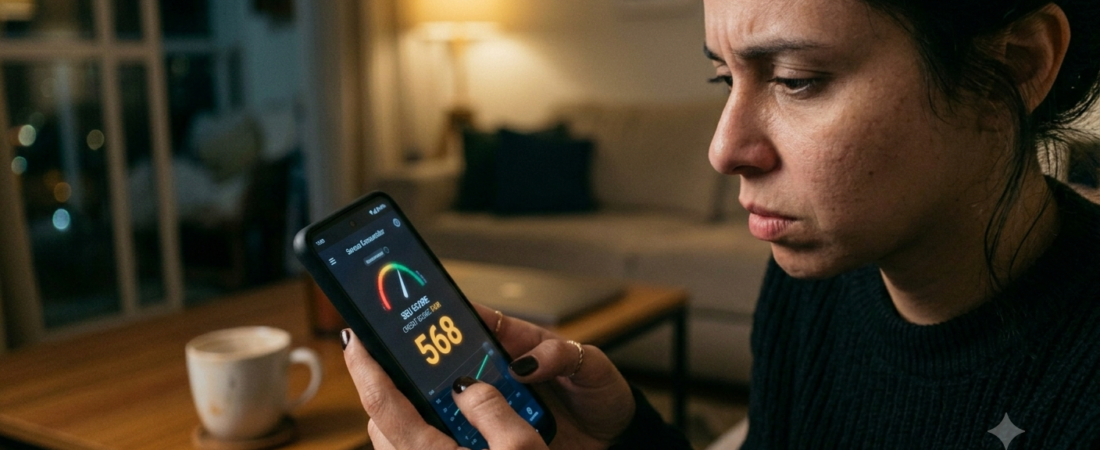
For almost two years, I had an app on my phone that I refused to open. Not a dating app. Not even my bank’s app. It was Credit Karma — the free credit score app I’d downloaded, used once, and then quietly let sit on my home screen like a tiny, glowing reminder of my own avoidance.
Every time I saw the little red notification badge, I’d feel this tiny drop in my stomach. Like opening it might “make it real.” Like the number might somehow get worse just because I looked at it. So I didn’t. I went almost two years without checking my credit score, not because I was busy, but because I was scared of what I’d see.
If that sounds familiar, you’re definitely not the only one. And the good news? Almost everything I believed about checking my score was wrong.
The Year I Avoided My Credit Score Like It Was a Bad Text Message
Here’s the thing about avoidance: it doesn’t feel like avoidance from the inside. It feels like “I’ll deal with that later.” It feels like “today’s not a good day for this.” It feels like a hundred small decisions that all add up to the same outcome — not knowing.
I told myself I was too busy. I told myself it didn’t matter because I wasn’t applying for anything big. But honestly? I think I just didn’t want to find out that all those months of credit card balances I’d been carrying had actually done damage. As long as I didn’t look, I could keep believing it was “probably fine.”
Turns out, this is incredibly common. Plenty of Americans deal with this same low-grade dread — not just about credit scores, but about money in general. A lot of us would rather not know than know and have to deal with it.
Does Checking Your Credit Score Actually Hurt It? (No — Here’s the Truth)
No — checking your own credit score is what’s called a “soft inquiry,” and it has zero impact on your score. Only “hard inquiries,” which happen when a lender checks your credit during a loan or credit card application, can cause a small, temporary dip. You can check your own score as often as you want — daily, even — through free tools like Credit Karma, Experian, or your bank’s app, with absolutely no penalty.
I want to sit with that for a second, because it was genuinely news to me. I had it backwards. I thought looking was the risky part. The risk was never in looking — it was in the years of not knowing what I was working with.
Why Our Brains Treat Bad Financial News Like a Threat
There’s actually a name for this — psychologists call it the “ostrich effect.” It’s our tendency to avoid information that might be unpleasant, even when that information could help us. Investors do it with their portfolios during a market dip. People do it with their bank balances after a big spending weekend. And a lot of us do it with our credit scores.
It makes sense when you think about it from an evolutionary standpoint. Our brains are wired to avoid threats, and uncertainty feels safer than confirmed bad news — at least in the short term. The problem is that money doesn’t work like a predator hiding in the bushes. Ignoring it doesn’t make it go away. It just means you’re making every financial decision blindfolded.
The CFPB has flagged how often credit report errors and confusion contribute to consumer stress, which tells you this isn’t just “you” being dramatic — it’s a system that’s genuinely intimidating by design.
The Number Isn’t a Report Card on You as a Person
Here’s something I had to unlearn: your credit score is not a measure of your worth, your intelligence, or your “adulting” skills. It’s a snapshot of how a handful of financial habits — payment history, balances, length of credit — looked at one point in time. That’s it.
It’s easy to internalize a low score as “I’m bad with money” or “I’m behind in life.” But a 580 doesn’t mean you’re irresponsible — it might mean you went through a rough patch, missed a payment during a layoff, or just never built credit history in the first place because nobody taught you how. The number describes a situation. It doesn’t describe you.
And if you’re starting from zero — no credit history at all — that’s not a bad score, it’s just an empty page. There’s a real difference between the two.
What Actually Happens When You Pull Your Score
When I finally opened that app again, here’s what actually happened: nothing dramatic. I saw a number. I saw a list of my accounts, my payment history, and my credit utilization — basically, how much of my available credit I was using.
My score wasn’t great, but it also wasn’t the disaster I’d built up in my head. It was just… information. Specific, useful, actionable information that I’d been avoiding for no real reason.
That’s usually how it goes. The number itself rarely matches the size of the dread leading up to it. The anxiety is almost always worse than the reality — because anxiety thrives on the unknown, and the unknown is exactly what disappears the moment you look.
How to Turn “Checking” Into a Habit Instead of a Dreaded Event
The trick that worked for me wasn’t willpower — it was making the act of checking boring. Routine. Unremarkable. Here’s how:
- Pick a low-stakes day. Don’t check your score right after a big purchase or a stressful bill. Check it on a random Tuesday when nothing’s riding on it.
- Set a recurring reminder. Once a month, same day, like a recurring calendar event — not a “someday I’ll get to it” task.
- Use a free monitoring app. Apps like Credit Karma or Experian update your score regularly and send mild, non-scary notifications instead of one big reveal.
- Separate “checking” from “fixing.” You don’t have to solve everything the moment you look. Checking is just step one — give yourself permission to just gather information first.
Once I started checking monthly instead of avoiding it for years, the emotional charge around it basically disappeared. It became as routine as checking the weather.
Okay, I Looked — Now What Do I Do With This Number?
Once you actually see your score, you’re in a completely different position than you were five minutes ago — because now you can do something with it. Maybe that means disputing an error you didn’t know was there. The CFPB notes that errors on credit reports are common, and you have the legal right to dispute inaccurate information for free.
Or maybe your score is fine but could be better — in which case, here are five small habits that move the needle fast, without requiring a complete financial overhaul.
If you want ongoing visibility without the mental overhead, a free credit monitoring app is genuinely worth setting up once and forgetting about — it does the “checking” for you in the background.
And if part of your avoidance was tied to broader money stress — not just the score itself — pairing this with a simple budget can take a lot of that pressure off at the same time.
FAQ: Quick Answers for the Credit-Score-Avoidant
Will checking my credit score multiple times hurt it?
No. Checking your own score is a soft inquiry and doesn’t affect your score at all, no matter how often you do it.
What’s the difference between a soft inquiry and a hard inquiry?
A soft inquiry happens when you check your own credit or when a company does a background-style check — it’s invisible to your score. A hard inquiry happens when you apply for credit, like a credit card or loan, and can cause a small, temporary dip.
What if my score is lower than I expected?
That’s useful information, not a verdict. A lower-than-expected score usually points to one or two specific factors — like high credit utilization or a missed payment — that you can address directly once you know about them.
How often should I actually check my credit score?
Once a month is plenty for most people. It’s frequent enough to catch errors or changes early, but infrequent enough that it doesn’t become a source of obsessive checking.
I haven’t checked mine in years — where do I even start?
Start with a free tool like Credit Karma, Experian, or your bank’s app — or get your full credit report for free at AnnualCreditReport.com. No cost, no commitment, and it’s the single best first step.