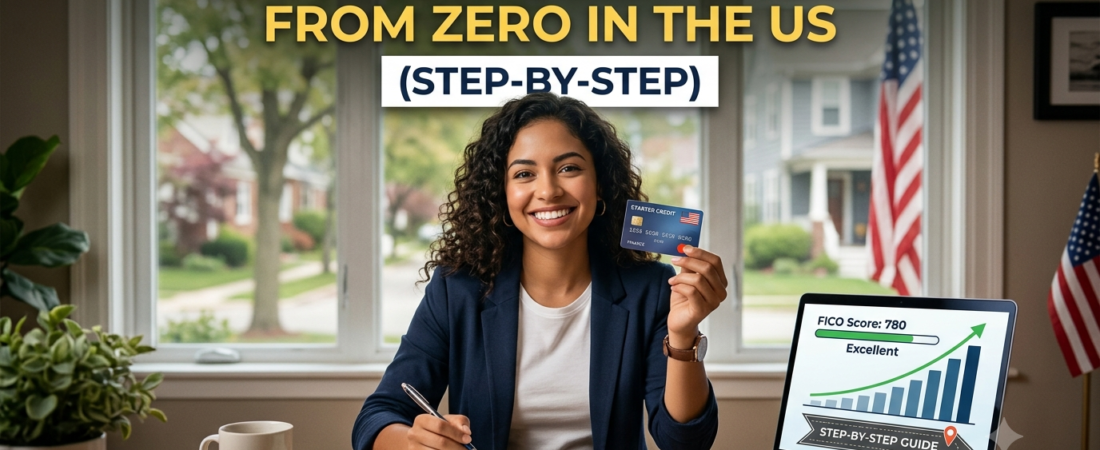
No credit history? Here’s exactly how to build credit from zero in the US — which accounts to open, what mistakes to avoid, and how long it actually takes.
how-to-build-credit-from-zero
How to Build Credit from Zero in the US — Your Step-by-Step Beginner’s Roadmap
If you’ve never had a credit card or loan in the US, you don’t have a bad credit score — you have no credit score at all. That’s called being “credit invisible,” and it affects tens of millions of Americans. Landlords reject you. Lenders charge you higher rates. Some employers won’t even hire you. But there’s a clear, proven path out of it — and you can start today with as little as $200.
This guide gives you the full roadmap: what credit really is, which accounts to open first, and exactly what to expect month by month.
What Does “No Credit Score” Actually Mean?
Having no credit score means the three major credit bureaus — Equifax, Experian, and TransUnion — have no record of how you handle borrowed money. Since there’s no data, there’s no score. You’re not rated poorly; you simply don’t exist in the system yet. According to FICO (the company behind the most widely used credit scoring model), you need at least one open account with six months of activity before a score can even be generated.
This matters more than most people realize. In the US, your credit score affects:
- Renting an apartment — most landlords run a credit check before approving your application
- Car loans and mortgages — no score often means automatic rejection or very high interest rates
- Utility accounts — some providers require a large security deposit if you can’t show a credit history
- Insurance premiums — in most states, insurers use credit data to set your monthly rate
- Employment — certain jobs, especially in finance or government, include a credit check as part of the hiring process
The good news: building credit from zero is actually easier than rebuilding bad credit. You’re starting with a blank slate, not digging out of a hole.
How Your Credit Score Is Calculated — The 5 Factors That Matter
Before you do anything, understand what you’re building toward. The FICO score — which ranges from 300 to 850 — is calculated from five factors. Every action you take either helps or hurts one of them.
- Payment History — 35%. The single biggest factor. Every on-time payment builds your score. Every missed payment damages it — and a payment that’s 30+ days late can drop your score by 50–100 points.
- Credit Utilization — 30%. This is how much of your available credit limit you’re actually using. If your credit card has a $300 limit and you’ve charged $150, your utilization is 50% — that’s too high. Keep it below 30% (under $90 on a $300 limit). Under 10% is even better.
- Length of Credit History — 15%. Older accounts help your score. This is why you should never close your first credit card — keep it open even if you barely use it.
- Credit Mix — 10%. Having both a credit card (revolving credit) and a loan (installment credit) shows you can handle different types of debt. Not critical when starting out, but helpful over time.
- New Credit Inquiries — 10%. Every time you apply for a new card or loan, a “hard inquiry” is recorded and can temporarily lower your score by a few points. Don’t apply for multiple cards in a short period.
The takeaway: pay on time, keep your balances low, and be patient. Those two habits alone — payment history (35%) and utilization (30%) — control 65% of your score.
Step 1 — Open a Secured Credit Card (The Best Starting Point)
A secured credit card is a credit card that requires a refundable security deposit, which becomes your credit limit. For example, you deposit $200 and get a $200 credit limit. The deposit protects the bank — so they’re willing to approve you even with zero credit history.
Here’s how to use it correctly:
- Pick one small recurring expense to put on the card — a streaming subscription, your phone bill, or a weekly grocery run. Aim to charge $20–$50/month.
- Pay the full balance every month, before the due date. Not just the minimum — the full amount. This keeps your utilization low and means you pay zero interest.
- Set up autopay for the full statement balance so you never miss a payment.
- Keep the card open and don’t apply for anything else for at least 12 months.
The card reports your activity to the three credit bureaus every month. Each on-time payment is a positive mark on your record. After 6–12 months of this, you’ll have a real credit score.
Which Secured Card Should You Get?
Look for these three things: no annual fee (or a very low one), reports to all three credit bureaus (Equifax, Experian, TransUnion), and a clear path to upgrade to an unsecured card after 6–12 months of responsible use. Three solid options for beginners:
- Discover it® Secured Credit Card — No annual fee, reports to all 3 bureaus, automatic review for upgrade after 7 months, and even earns cash back. One of the best starter cards available.
- Capital One Platinum Secured Credit Card — No annual fee, access to a higher credit limit after 6 months of on-time payments.
- Chime Credit Builder Visa® — Works a bit differently: no hard credit check to apply, and your spending limit is based on what you transfer from your Chime checking account. Good if you can’t qualify for others.
Step 2 — Consider a Credit-Builder Loan (Optional but Powerful)
A credit-builder loan is different from a regular loan. You don’t receive the money upfront. Instead, the lender holds the amount — typically $300 to $1,000 — in a savings account. You make small monthly payments (usually $25–$50/month) over 6 to 24 months. Once you’ve paid it off, you get the money back.
The real benefit: every monthly payment gets reported to the credit bureaus as an installment loan payment. This builds your payment history AND adds a different type of credit to your file (credit mix), which helps your score.
Where to get one: many credit unions and community banks offer credit-builder loans. Self (self.inc) is a popular online option that works the same way and doesn’t require a credit check to apply.
You don’t need both a secured card and a credit-builder loan to start. One is enough. But if you can afford the payments on both, using them together can speed up your credit-building timeline significantly.
Step 3 — Become an Authorized User (If You Have the Right Person to Ask)
If a parent, spouse, or close family member has a credit card with a good payment history and low balance, ask them to add you as an authorized user on their account. You don’t even need to use the card — just being listed on the account means their positive history gets added to your credit report.
Important: make sure the card issuer reports authorized users to all three credit bureaus. Most major issuers (Chase, Citi, American Express, Capital One) do — but confirm before moving forward.
One key warning: if the primary cardholder misses payments or carries a high balance, it will hurt your credit too. Only do this with someone you fully trust and whose account is in good standing.
Step 4 — Get Credit for Bills You Already Pay
Most rent and utility payments don’t automatically show up on your credit report. But several services can change that:
- Experian Boost — Free tool that adds your on-time phone, utility, streaming, and rent payments to your Experian credit file. It won’t hurt your score, and it often provides an instant small boost.
- Rental reporting services — Services like Rental Kharma or Rent Reporters can report your rent payments to credit bureaus for a small monthly fee. If you’ve been renting for a while and paying on time, this can add months of positive history immediately.
These tools won’t build your score on their own, but they supplement your main credit-building accounts nicely — especially in those first few months when you don’t have much history yet.
How Long Does It Actually Take? A Realistic Timeline
Here’s what to expect, month by month, if you open a secured credit card and use it responsibly:
- Month 1–2: Account opens and activity starts being reported. No score yet — that’s normal.
- Month 3–6: Your first credit score appears. It will likely be in the “Fair” range — somewhere between 580 and 650. Not great, but you exist in the system now.
- Month 6–12: With consistent on-time payments and low utilization, your score climbs into the 650–700 range. You become eligible for most apartment rentals and many basic credit products.
- Month 12–24: Score reaches 700+ territory. You can qualify for better credit cards, reasonable car loan rates, and start being taken seriously by lenders.
- Year 2+: With continued good habits, scores of 740–780 are realistic — a range that unlocks the best interest rates and terms on mortgages and auto loans.
Building from zero to a genuinely good credit score (700+) takes roughly 12 to 18 months of consistent behavior. There are no shortcuts that skip this timeline — only habits that get you there faster or mistakes that set you back.
5 Mistakes That Will Destroy Your Credit Progress
- Maxing out your secured card. If your limit is $300 and you charge $250 on it, your utilization is 83%. That tanks your score even if you pay it off every month. Charge no more than $90 on a $300 limit — ideally less.
- Missing a single payment. One payment that goes 30 days past due can drop your score by 50–100 points and stays on your report for 7 years. Set up autopay. There is no excuse for a missed payment in the age of automatic billing.
- Applying for multiple credit cards at once. Each application triggers a hard inquiry and temporarily lowers your score. Pick one card, use it well for 12 months, then consider adding another.
- Closing your first credit card. Length of credit history is 15% of your score. Closing your oldest card shortens your history and can lower your score. Keep it open with a small recurring charge on it.
- Using the card as extra money. Your secured card is a credit-building tool, not an extension of your paycheck. Treat every charge like cash you already have in your checking account — because you’ll need to pay it in full at month end.
Your Action Plan: What to Do This Week
- Check if you have any existing credit history by visiting AnnualCreditReport.com — the official free site where you can pull your credit reports from all three bureaus. This is free and doesn’t affect your score.
- Apply for the Discover it® Secured Credit Card (or Capital One Platinum Secured if Discover doesn’t work out). Make a $200–$300 deposit to open the account.
- Set one small recurring bill to charge to the card — your Netflix subscription, your phone payment, or a weekly gas fill-up.
- Set up autopay for the full statement balance so you never miss a payment.
- Sign up for Experian Boost (free) to get credit for bills you already pay.
- Put a reminder on your calendar for 6 months from now to check your credit score and assess whether to add a second card or a credit-builder loan.
- Check your score monthly using a free tool like Credit Karma, Experian’s free app, or the free score your card issuer provides — without it ever affecting your score.
Frequently Asked Questions
Can I build credit with no job or a low income?
Yes. A secured credit card requires a deposit, not proof of income. As long as you can put down $200 and make small monthly charges you can pay in full, you can build credit regardless of your employment situation. A credit-builder loan works the same way.
Does checking my own credit score hurt it?
No. Checking your own score is called a “soft inquiry” and has zero impact on your credit. Only “hard inquiries” — when a lender checks your credit because you applied for something — temporarily lower your score slightly.
Can I build credit without a credit card?
Yes, through a credit-builder loan or by being added as an authorized user on someone else’s account. However, a secured credit card is the most accessible and fastest option for most beginners.
What credit score do I need to rent an apartment?
Most landlords look for a score of at least 620–650. With 12 months of responsible secured card use, most people reach that range. Some landlords in competitive markets prefer 700+.
Start Now — Every Month You Wait Is a Month of Credit History You’ll Never Get Back
Your credit score is built on time and consistency. There’s no hack that replaces 12 months of on-time payments. But the flip side is just as true: 12 months from now, you could have a real, working credit score — or you could be exactly where you are today, explaining to a landlord why you can’t pass a credit check.
Open a secured card this week. Set up autopay. Charge one small bill to it each month. That’s all it takes to start.
Next step: Once your credit score is building, the next financial priority is making sure an unexpected expense doesn’t force you into debt and undo your progress. A small emergency fund is what protects the credit score you’re working to build.