
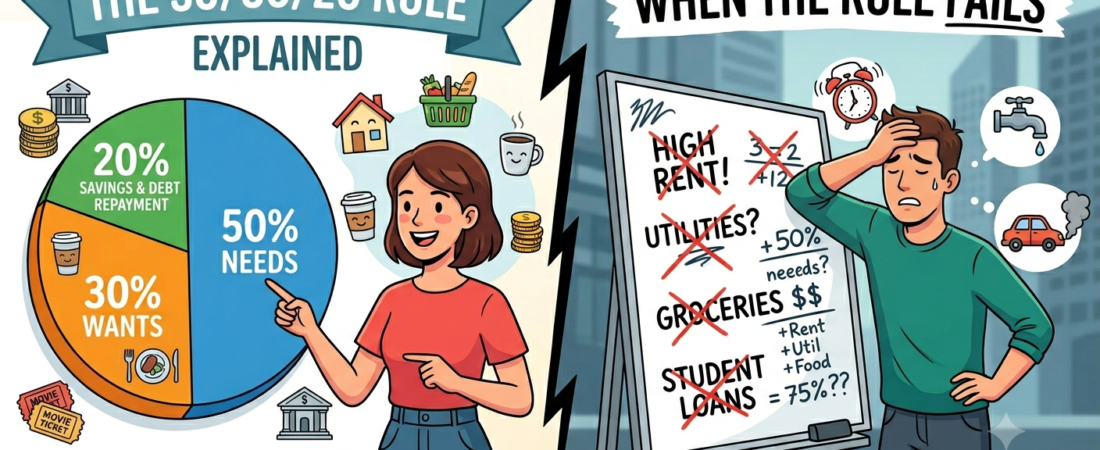
I remember sitting at my kitchen table with a notebook, genuinely excited to finally try the 50/30/20 rule. I’d heard about it everywhere — personal finance podcasts, Reddit threads, a coworker who swore by it. The idea seemed almost too simple: split your after-tax income into three buckets, follow the percentages, done. I was ready.
Then I did the actual math.
My take-home pay at the time was about $3,400/month. Fifty percent of that — the “needs” bucket — was $1,700. My rent alone was $1,650. Before groceries. Before utilities. Before the car insurance payment or the minimum on my student loan. My rent, by itself, consumed 48.5% of my entire take-home pay. The rule said I had $50 left for every other necessity in my life.
I closed the notebook. Not because I didn’t want to budget — I genuinely did. But because a framework that required me to either spend $650 less on rent (not realistic) or somehow earn 40% more (also not immediately realistic) wasn’t actually a framework. It was a math problem with no solution for my actual life.
What I wish someone had told me then: the 50/30/20 rule isn’t wrong, exactly. It’s just designed for a financial situation that a lot of Americans don’t have. And knowing that distinction — understanding who it works for and who it doesn’t, and what to do if you fall in the second category — is worth more than any percentage chart.
What the 50/30/20 Rule Actually Is
The 50/30/20 rule divides your after-tax income into three categories: 50% for needs (rent, utilities, groceries), 30% for wants (dining, entertainment, subscriptions), and 20% for savings and debt repayment. It’s designed as a simple starting framework, not a rigid formula — and for many Americans, especially those in high-cost cities or on lower incomes, the percentages need significant adjustment.
That’s the definition. Now let’s talk about where it came from, because the origin matters more than most people realize.
Where the Rule Comes From — And Who It Was Designed For
The 50/30/20 rule was popularized by Senator Elizabeth Warren and her daughter Amelia Warren Tyagi in their 2005 book “All Your Worth: The Ultimate Lifetime Money Plan.” Warren, then a Harvard bankruptcy law professor, developed the framework based on research into American household finances — specifically, she was studying why middle-class families were going bankrupt despite decent incomes.
The book was designed for families who had enough income to theoretically cover their needs comfortably, but were overspending on wants and undersaving for the future. The 50% needs ceiling was calibrated for a household where housing, transportation, and essentials were consuming roughly half of income — which, in 2005, was a reasonable approximation of reality for a significant portion of middle-income American households.
Two decades later, that assumption has become significantly less accurate. Housing costs have outpaced wage growth in almost every major US metro area. Childcare costs have risen dramatically. Health insurance premiums have increased. And median household income, adjusted for inflation, hasn’t kept pace with the cost of the fixed expenses that make up the “needs” category. The rule was designed for a specific financial landscape — and for many Americans, that landscape no longer exists.
The Math Problem: Why 50% for “Needs” Doesn’t Work for Most Americans
Here’s the statistic that most 50/30/20 articles mention in a footnote and then move past: according to Census Bureau income data and average expense figures, the median American household spends more than 80% of take-home pay on needs alone — before a single “want” category gets funded. Not 50%. Eighty percent.
Let’s put that in real numbers at a few income levels:
- Take-home pay of $3,000/month: The 50% needs budget is $1,500. Median rent in the US hit over $1,400/month in 2026 — meaning the rent alone eats 93% of the “needs” allowance before utilities, groceries, insurance, or transportation.
- Take-home pay of $4,500/month: The needs budget is $2,250. More workable in lower-cost areas — but in cities like New York, Los Angeles, San Francisco, Seattle, Austin, or Miami, a one-bedroom apartment frequently runs $2,000-3,000+, which blows the ceiling immediately.
- Take-home pay of $7,000/month: Now the math starts to work — $3,500 for needs, $2,100 for wants, $1,400 for savings. This is roughly the income level the rule was calibrated for.
This isn’t a criticism of the rule — it’s a description of who it was built for. If your fixed costs eat 70-80% of your income, the 50/30/20 framework isn’t failing you because you’re doing it wrong. It’s failing you because it was designed around cost structures and income levels that don’t describe your reality.
The Psychology Problem: When “Needs vs. Wants” Gets Blurry
Even when the math theoretically works, the 50/30/20 rule has a second problem: the line between “needs” and “wants” is far blurrier in real life than it looks on a percentage chart.
Is your phone bill a need or a want? It’s required for work, navigation, and emergency contact — but it’s also how you stream music and scroll social media. Is a slightly higher grocery budget that includes some convenience foods a need (you’re exhausted and need to eat something) or a want (technically you could meal prep)? Is the car insurance on a car you need to get to work a need — yes, obviously — but what about the car itself, which you chose with a payment that’s above the absolute minimum?
Financial literacy educator Kyle Boze puts it this way: a better labeling might be “living essentials” versus “lifestyle choices” — with the understanding that the boundary between them shifts depending on your life circumstances, your location, your health, and your job. A $150/month gym membership might be a pure want for one person and a mental health essential for another. The 50/30/20 rule doesn’t have a slot for that nuance — it just has three buckets and expects you to know which one each expense belongs in.
In practice, this ambiguity leads to one of two failure modes: over-categorizing expenses as “needs” until the needs bucket is 75% of income and the framework is meaningless, or under-categorizing them as “wants” and feeling guilty about spending that’s actually legitimate, which eventually makes the system feel punishing enough to abandon.
Who the 50/30/20 Rule Actually Works For
I want to be balanced here, because the rule has genuine value for the right person in the right situation. Here’s an honest profile of who it works well for:
- People whose fixed costs are actually under 50% of take-home pay. If you live in a lower cost-of-living area, have a roommate, own your home with a manageable mortgage, or have otherwise structured your fixed expenses to leave real room, the math works and the framework gives useful structure.
- People new to budgeting who need a simple starting point. The 50/30/20 rule’s biggest strength is that it requires almost no setup — no categories, no apps, no tracking every transaction. For someone who’s never budgeted before and is overwhelmed by complexity, it’s a reasonable first experiment.
- People with moderately high incomes who are spending too much on wants. This is the Warren/Tyagi original use case — someone earning enough to cover needs comfortably but spending it on lifestyle at the expense of savings. For this person, the “30% wants” ceiling is genuinely useful as a gut check.
- People in a transitional phase — recent college graduate with low rent, someone who just got a significant raise — where the numbers happen to line up and a simple framework is more valuable than a detailed one.
When It Doesn’t Work — And What to Use Instead
Here’s a more specific list of situations where the 50/30/20 rule is likely to frustrate rather than help:
- Your fixed costs exceed 60-65% of take-home pay. At this level, there’s no version of the rule that works without a significant income increase or reduction in fixed costs — and “just adjust the percentages” isn’t a plan, it’s just arithmetic on a different set of numbers.
- You’re carrying significant high-interest debt. The 20% savings/debt bucket has to absorb both emergency savings and debt repayment simultaneously, which at most income levels isn’t enough to meaningfully attack high-APR balances while also building any savings cushion.
- Your income is variable. Percentage-based budgeting works poorly on variable income because “30% of this month’s income” is a different dollar amount every month, which makes the framework feel unstable.
- You’ve already cut spending to the bone. If your “wants” category is already near zero and you still can’t hit the percentages, you’re not dealing with a budgeting method problem — you’re dealing with an income problem, and why cutting expenses doesn’t always solve the problem is worth understanding before you blame the framework.
If the 50/30/20 rule doesn’t fit your situation, a simpler three-category budget that works regardless of income — built around your actual fixed costs rather than theoretical percentages — is often a more useful starting point.
How to Adapt It Without Abandoning It: The “Compass, Not GPS” Approach
Here’s the reframe that I think makes the 50/30/20 rule most useful, even for people whose numbers don’t fit the standard percentages: treat it as a compass that points toward a direction, not a GPS that gives you turn-by-turn instructions.
A compass tells you you’re heading roughly east, even if the exact path is full of obstacles. The 50/30/20 rule tells you roughly where you should be heading — toward a life where needs don’t consume all of your income, where wants are bounded, and where savings are a genuine line item rather than “whatever’s left.” Even if you can’t hit the exact percentages right now, knowing the direction is useful.
In practice, the adaptive version looks like this:
- Start with your actual numbers. What percentage of your take-home pay actually goes to fixed costs right now? That’s your real starting point, not 50%.
- Set a directional goal, not a rigid target. If your needs are currently at 72%, the goal isn’t to hit 50% by next month — it’s to move toward 65%, then 60%, as income increases or fixed costs change.
- Make savings non-negotiable, even at small percentages. If 20% is impossible, make it 5%. A smaller savings percentage you actually maintain is infinitely more valuable than a 20% target you abandon after two months.
- Prioritize the savings category intentionally. Even a small savings percentage should have a specific destination — building an emergency fund as part of that savings percentage is typically the highest-impact first use, before anything else.
The 50/30/20 rule, used as a compass rather than a mandate, is actually a reasonably useful framework — it’s just been marketed as a universal solution when it’s really a starting template that most people will need to adapt significantly to their real circumstances.
FAQ: Real Questions About the 50/30/20 Rule
Should I count my minimum debt payments as “needs” or “savings/debt”?
Technically, they belong in the 20% savings/debt repayment category — but practically, they’re as fixed and mandatory as rent, which is why some financial planners include minimums in the “needs” bucket and only count extra debt payments in the 20%. Either approach works as long as you’re consistent and not double-counting.
Is the 50/30/20 rule pre-tax or post-tax?
Post-tax — your take-home pay after income taxes and any pre-tax deductions (health insurance premiums, 401k contributions) have been removed. Using gross income inflates the percentages and makes the budget look more flexible than it actually is.
My needs are at 65%. Should I just give up on the rule?
No — adjust the percentages to reflect your reality and use the rule directionally. A 65-15-20 split (needs-wants-savings) where you’re still setting aside 20% for savings is more useful than a perfect 50/30/20 you can’t actually hit. The savings percentage matters more than the needs percentage.
Can I combine the 50/30/20 rule with other budgeting methods?
Yes — and this is often where people find the most traction. Using the 50/30/20 rule as a high-level check while using a more granular method (like zero-based budgeting) within the “wants” category gives you structure at both the macro and micro level without requiring you to choose between simplicity and detail.
What if I want to save more than 20%?
Save more. The 20% is a minimum guideline, not a ceiling. If your needs are genuinely under 50% and your wants can be compressed below 30%, there’s nothing in the rule that prevents directing 30% or 35% to savings and wealth-building — in fact, that’s exactly what the rule’s directional logic points toward as income grows.