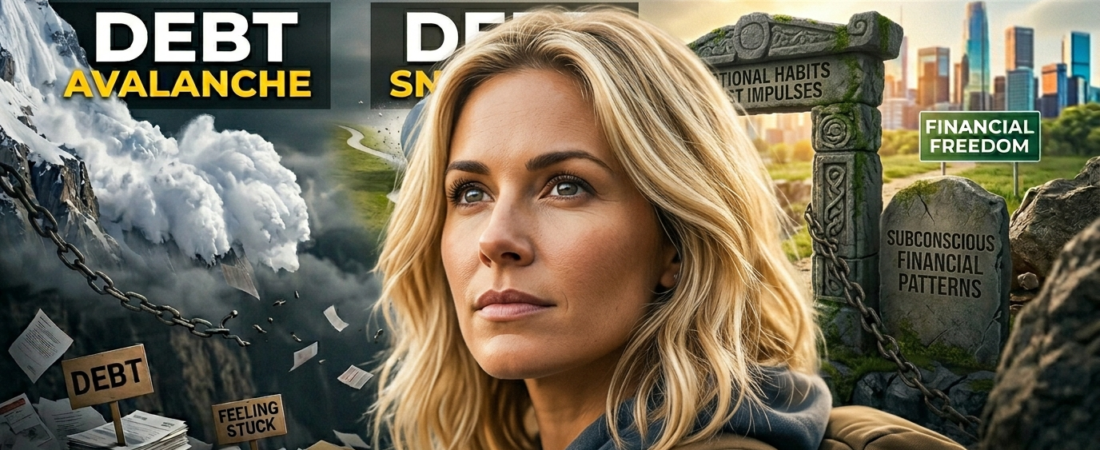
You’ve done it before. You scraped together extra payments, said no to things you wanted, watched the balance drop — and then one day it hit zero. Or close enough to zero that it felt like freedom. You told yourself: never again.
And then, somewhere between six months and two years later, you were back. Maybe it was a car repair. Maybe it was a trip you felt like you deserved after everything you’d been through. Maybe you’re not even sure exactly how it happened — just that the balance crept back up and now you’re staring at a number that looks uncomfortably familiar.
This isn’t a story about failure. It’s a story about a pattern. And patterns have explanations. The explanation, almost never, is that you don’t have enough willpower.
Why You Keep Going Back Into Debt (It’s Not About Willpower)
Most people return to debt not because they lack discipline, but because they fixed the balance without fixing the behavior that created it. Paying off a credit card doesn’t change how you make spending decisions under stress, boredom, or social pressure. Until the underlying pattern is identified and interrupted, the debt comes back — often within months of being paid off.
The Difference Between Paying Off Debt and Getting Out of Debt
These sound like the same thing. They’re not.
Paying off debt is a math event. You put enough money toward a balance until it reaches zero. It’s measurable, finite, and satisfying in the way that checking a box is satisfying.
Getting out of debt is a behavioral shift. It means the decisions, habits, and emotional responses that generated the debt in the first place have actually changed. Without that shift, a zero balance is just a reset button — and the cycle starts over.
Research published in the American Economic Review studied what happened when people had their high-interest debt paid off entirely on their behalf. The result was striking: most borrowers returned to debt within six weeks. One to two years later, they were borrowing at the same rate as people who’d never received any help at all. The debt wasn’t the root problem. The debt was a symptom.
That’s the uncomfortable truth this article is built around. Not to make you feel hopeless — but because understanding it is the only way to actually break the cycle instead of just interrupting it temporarily.
The Real Reasons the Cycle Repeats
There’s rarely one single cause. But there are patterns that show up again and again — specific, recognizable, and fixable once you can name them.
1. You treated the symptom, not the cause
You paid off the credit card. But the reason the card got maxed out in the first place — the irregular income, the emotional spending after hard weeks, the habit of using credit as a buffer — was never addressed. The card is clean. The system that filled it is still running.
2. Present bias: your brain is not built for delayed gratification
Behavioral economists call it present bias — the deeply human tendency to overvalue what’s available right now and undervalue what happens later. It’s not a character flaw. It’s how human brains are wired, especially under stress. When you’re tired, overwhelmed, or having a bad week, the future consequences of a purchase genuinely feel less real than the immediate relief of making it. Credit cards are specifically designed to exploit this gap.
3. Emotional spending without a replacement habit
For a lot of people, spending is a coping mechanism — for stress, boredom, loneliness, or the feeling of deserving something good after something hard. Paying off debt doesn’t remove those emotions. It just removes the financial cushion that was absorbing them. Without a different outlet — one that doesn’t cost money — the spending comes back the moment life gets difficult again. And life always gets difficult again.
4. Social pressure that never went away
Your friends still go out. Your coworkers still do the group lunch. Your family still expects gifts at the holidays. The social architecture of your life didn’t change while you were paying down debt — and now that the balance is zero, the pressure to participate feels justified. I paid everything off, I deserve this trip. And just like that, the card has a balance again.
Your Debt Might Be Tied to Your Identity
This is the one nobody wants to hear — and the one that matters most for people who’ve cycled through debt payoff more than once.
Some people, at a level below conscious thought, have internalized being in debt as part of who they are. Not because they’re irresponsible or broken, but because debt has been a constant in their life for so long that being without it feels unfamiliar. Unstable. Like something is missing.
This shows up in subtle ways. The sudden loosening of spending discipline right after a big payoff. The quiet sense that financial stability is for “other kinds of people.” The feeling that things were somehow simpler when the problem was defined — at least then you knew what you were fighting.
Psychologists call this a self-concept threat: when your behavior starts to contradict your internal image of yourself, there’s an unconscious pull to realign. If your internal story is I’m someone who struggles with money, then succeeding with money creates a kind of cognitive dissonance that some people resolve — without realizing it — by recreating the familiar struggle.
Recognizing this isn’t about blame. It’s about understanding that for some people, breaking the debt cycle requires changing not just their habits, but their story about who they are with money.
The Situations That Pull You Back In
Abstract causes are useful to understand. Concrete triggers are what actually get you. Here are the specific situations that send people back into debt most often — and why each one works so effectively:
The tax refund that becomes permission to spend
The average American tax refund in recent years has been over $3,000. For someone who just paid off debt, that refund can feel like a reward — money that materialized from nowhere and therefore doesn’t quite count the same way as earned income. The refund gets split, spent, or used to upgrade something “practical.” Six months later, a new balance has quietly grown to match it.
The trip you feel like you deserve
You spent a year saying no. You were disciplined when everyone around you wasn’t. You paid it off. And now your friends are planning a trip and the voice in your head says you’ve earned this. That voice isn’t wrong about the sacrifice. It’s wrong about the math. One trip on a credit card with no payoff plan is how the next cycle starts.
The rewards card that becomes a spending license
You switch to a rewards card because the points seem smart. You start putting everything on it. You lose track of what you’re actually spending because you’re thinking in points, not dollars. You pay the balance down but not off. The minimum payments feel manageable. Sound familiar? The card isn’t the problem — the system around it is.
The emergency that the buffer didn’t cover
You had a small emergency fund. The emergency was bigger. The card covered the difference. This one isn’t behavioral — it’s structural. The fix isn’t motivation; it’s a larger buffer and a better plan for irregular expenses. If you’re still building that foundation, our guide on how to get out of debt fast walks through exactly how to build the financial structure that makes relapse less likely.
Crisis Debt vs. Behavior Debt: Which One Is Yours?
Not all debt cycles are the same — and mixing them up leads to the wrong solutions.
Crisis debt
This is debt that happened because of something outside your control: a medical emergency, a job loss, a divorce, a death in the family that created unexpected expenses. The cycle repeats not because of spending habits but because income is unstable or expenses are structurally too high for what you earn. No amount of behavioral work fixes an income problem. The real intervention here is income growth, public assistance, or negotiating expenses — not journaling about spending triggers.
Behavior debt
This is debt that accumulates through patterns of decision-making — emotional spending, lifestyle inflation, social pressure, using credit as an income supplement when you make enough to live without it. This is where the behavioral work matters. Not as a replacement for a budget or a payoff plan, but as the layer underneath it that makes those tools actually stick.
Most people carry some mix of both. The honest question to ask is: If my income stayed exactly the same but my spending decisions changed, would I still be in this cycle? If the answer is yes, the crisis component is real and needs to be addressed structurally. If the answer is no, the behavioral work is where your leverage is.
What Actually Breaks the Cycle
Not motivation. Not another budget app. Not a promise to yourself that this time will be different. Those things help, but they’re not what actually creates lasting change. Here’s what does:
Name the pattern before the next trigger hits
The tax refund is coming. The friend group trip is already being planned. Your car has 90,000 miles on it. These are known variables — predictable pressure points that have pulled you back before. The people who break the cycle decide in advance what they will do when these moments arrive, instead of making the decision in the moment when present bias is strongest.
Build systems, not rules
Rules require willpower. Systems don’t. Auto-paying debt before you can spend the money, keeping a separate account for irregular expenses, having a specific dollar limit that triggers a 48-hour pause before any purchase — these are structural interventions that work even when motivation is low. And motivation will be low. Count on it.
Choose a payoff method and understand why you’re choosing it
The method matters less than the self-awareness behind the choice. If you’ve quit debt payoff plans before, you need momentum more than you need math. If you’re motivated by data and long-term thinking, the avalanche approach might finally click. Understanding which type of person you are — and why — is more valuable than finding the “optimal” strategy. Our breakdown of debt avalanche vs. debt snowball can help you make that call with clarity.
Change the story, not just the spreadsheet
If you’ve cycled through debt payoff more than twice, it’s worth sitting with this question: What do I believe about myself and money? Not what you know intellectually — what you actually believe at a gut level. That story, whatever it is, is running in the background of every financial decision you make. Changing it takes time and sometimes outside help. But it’s the only intervention that produces permanent results.
Know when to get outside help
If the cycle has repeated three or more times despite genuine effort, there’s no shame in talking to a nonprofit credit counselor through the NFCC, a financial therapist, or both. Financial therapy specifically addresses the emotional and psychological patterns behind money behavior — not just the numbers. It exists because the numbers alone have never been enough for everyone.
FAQ: Breaking the Debt Cycle
Is it normal to pay off debt and then go right back into it?
More common than most people realize. Research has shown that even when people have their debt paid off entirely on their behalf, the majority return to borrowing within weeks. This isn’t a character flaw — it’s evidence that behavior, not balance, is the real variable. The good news is that behavior can be changed deliberately, in ways that a lump sum payment can’t accomplish on its own.
How do I know if my debt cycle is behavioral or situational?
Ask yourself whether your income realistically covers your essential expenses without credit. If yes, the cycle is largely behavioral and the interventions in this article apply directly. If no — if you’re using credit to cover rent, utilities, or groceries despite working consistently — the problem is structural and requires income-focused solutions alongside any behavioral work.
What’s the fastest way to break the debt cycle?
There’s no fast version of a permanent fix. But the highest-leverage move is identifying your specific trigger — the one situation that has pulled you back into debt before — and building a concrete plan for that exact scenario before it happens again. Preparation beats willpower every time.
Should I cut up my credit cards to break the cycle?
Maybe — but it depends on why you’re in the cycle. If the card itself is the trigger, removing it makes sense. If the underlying behavior is emotional spending, you’ll find another vehicle for it. Cutting the card without addressing the pattern is like treating a fever without treating the infection. It might help short term; it won’t fix the root cause.
Can therapy actually help with debt?
Yes — specifically financial therapy, which combines financial planning with behavioral and emotional support. If you’ve noticed that your money decisions feel driven by anxiety, shame, or patterns that started long before you had your own finances, working with a financial therapist can be one of the highest-return investments you make. The NFCC is a good starting point for finding qualified, nonprofit-affiliated help.
How is this different from just needing a better budget?
A budget is a tool. Tools only work when the person using them has the context to use them correctly. If emotional spending, identity, or social pressure are driving your financial decisions, a budget tells you what’s happening — but it doesn’t change why it’s happening. You need both: the structure of a plan and the self-awareness to understand what keeps derailing it.