My cousin Marcus had a plan. A good one, actually. He listed all five of his debts, sorted them by interest rate, set up a spreadsheet, and committed to the debt avalanche method. He was going to do this the right way — the mathematically optimal way. He lasted four months.
The problem wasn’t the math. The math was fine. The problem was that four months in, he had made a real dent in his highest-interest credit card — but he still had four other debts sitting there, completely unchanged, staring back at him every time he opened that spreadsheet. It felt like he’d been running hard and gone nowhere. So he stopped running.
This is the part of the debt payoff conversation nobody wants to lead with: the most common outcome isn’t success or failure. It’s quitting. And which method you choose has a lot to do with whether you quit or not.
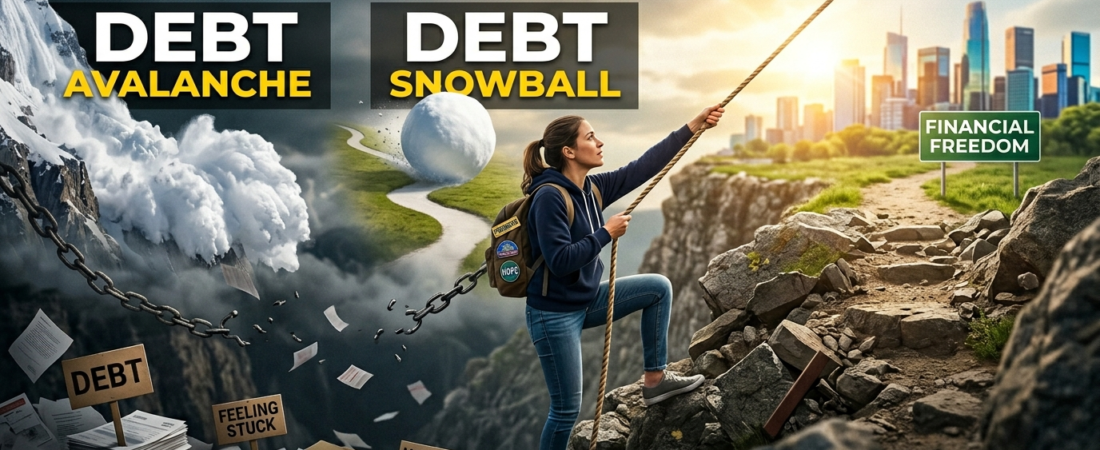
Debt Avalanche vs. Debt Snowball: Which One Actually Gets You Out of Debt?
The debt snowball pays off your smallest balance first to build momentum and motivation. The debt avalanche pays off your highest interest rate first to save the most money. Mathematically, the avalanche wins. Behaviorally, the snowball wins for most people. The best method is the one you’ll actually stick with — and that depends entirely on how you’re wired.
How the Debt Snowball Works (And Why It Feels So Good)
The snowball method is simple by design. You line up all your debts from smallest balance to largest. You pay minimums on everything. Then you throw every extra dollar at the smallest debt until it’s dead. When it’s gone, you take that payment and add it to the minimum on the next smallest debt. You repeat until there’s nothing left.
What makes this work isn’t the math — it’s the dopamine hit of actually finishing something. The moment you pay off that first debt, something shifts. It stops being an abstract plan and becomes a proven fact: I can do this. That psychological shift is more valuable than most people give it credit for.
Research backs this up. A study published in the Journal of Consumer Research found that people who focus on paying off individual accounts — rather than reducing overall balances — are more motivated and more likely to eliminate their debt entirely. Momentum is a real force, not a soft concept.
Best for: People who’ve tried to pay off debt before and quit. People who need to see visible progress to stay motivated. Anyone whose debt feels emotionally overwhelming rather than just financially inconvenient.
The honest downside: You will pay more in interest. If your smallest debt happens to be a low-APR personal loan and your largest is a 28% credit card, you’re letting that high-rate balance compound while you work through the line. Over months or years, that difference adds up to real money.
How the Debt Avalanche Works (And Why It’s Harder Than It Looks)
The avalanche method is the one your accountant would recommend. You list all your debts by interest rate, highest to lowest. You pay minimums on everything. Then every extra dollar goes toward the highest-rate debt first. When it’s gone, you move to the next highest rate. You repeat until finished.
The math here is unambiguous. By eliminating your most expensive debt first, you reduce the total interest you’ll ever pay — sometimes by hundreds, sometimes by thousands of dollars depending on your balances and rates.
So why does it fail so many people?
Because your highest-interest debt is often your largest balance. Which means months can go by — sometimes six, eight, twelve months — before you cross a single debt off the list. You’re making real progress that your spreadsheet confirms but your brain can’t feel. And when life throws a curveball — a car repair, a rough month, a moment of weakness — there’s no recent win to fall back on. No proof that the plan works. Just a long road with no landmarks.
Best for: People who are motivated by data and long-term optimization. People with high-interest debt that dwarfs everything else on their list. People who’ve successfully followed through on long-term plans before — in fitness, work, or other financial goals.
The honest downside: It demands patience that most humans — under financial stress — genuinely don’t have. That’s not a character flaw. It’s just how stress and motivation interact in the brain.
The Real Difference: A Side-by-Side Example in Actual Dollars
Let’s make this concrete. Say you have three debts and $300/month to apply beyond minimums:
- Credit card A: $3,500 balance at 24% APR — minimum $70/month
- Personal loan: $5,000 balance at 9% APR — minimum $110/month
- Credit card B: $1,200 balance at 19% APR — minimum $30/month
Using the Debt Snowball:
You attack Credit Card B first ($1,200 — smallest balance). It’s gone in roughly 4 months. That freed-up $30 rolls into the next target. You’re crossing something off the list before summer. The momentum is real and early.
Using the Debt Avalanche:
You attack Credit Card A first ($3,500 at 24% — highest rate). It takes roughly 10 months to eliminate. You don’t cross a single debt off the list for almost a year. But when you’re done, you’ve paid meaningfully less in total interest — potentially $400–$600 less over the full payoff period depending on how the numbers fall.
The avalanche saves you money. The snowball keeps you in the game. Both of those things matter — the question is which one matters more for you, right now.
Which Method Is Right for You? A Behavioral Profile
Forget the math for a second. Answer these honestly:
Choose the Debt Snowball if:
- You’ve started a debt payoff plan before and abandoned it
- Seeing the same balances month after month kills your motivation
- Your debts are relatively close in interest rate (within 5–8 points of each other)
- You’re dealing with financial anxiety or shame around debt — early wins help break that pattern
- You have several small debts cluttering your list that you could knock out quickly
Choose the Debt Avalanche if:
- You have one or two debts with very high APRs (20%+) that are significantly larger than the rest
- You’re motivated by data and tracking — watching interest charges drop month over month is satisfying, not frustrating
- You have a track record of following through on long-term plans
- The dollar difference in total interest paid is large enough to feel meaningful to you
- Your smallest debts are actually your highest-rate debts — in which case both methods agree anyway
And if you’re still not sure? Default to the snowball. The method that keeps you going is always better than the method that’s theoretically superior but gets abandoned by month five.
The Hybrid Approach: When You Use Both
Here’s something the comparison articles won’t tell you: you’re not locked in. The snowball and avalanche aren’t religions — they’re tools. And sometimes the smartest move is to use both.
One hybrid approach that works well in practice: start with the snowball. Pick off one or two small debts quickly to prove to yourself that the plan works and build some real momentum. Then shift to the avalanche for the remaining balances, where the interest savings become more significant and your motivation is already established.
Another version: if you have one debt that’s both small and high-rate, both methods agree — attack it first. That’s the sweet spot where math and psychology point in the same direction.
The point isn’t to follow a method perfectly. The point is to get out of debt. Use whatever combination of tools gets you there.
If you’re still working out the full picture of your debt situation before choosing a method, it helps to start with a clear plan. Our guide on how to get out of debt fast walks through the full step-by-step framework — including how to build your $500 buffer before you start attacking balances.
The Mistake That Kills Both Methods
There’s one behavior that derails people regardless of which method they choose: spending weeks researching the perfect strategy instead of starting.
It’s called analysis paralysis, and it’s especially common with debt because the stakes feel high. What if you pick the wrong method? What if you waste money on interest you could have avoided? What if there’s a better approach you haven’t found yet?
Here’s the reality: the difference in total interest between the snowball and avalanche, for most people’s debt loads, is a few hundred dollars over two to three years. The cost of waiting another month to start — while your balances compound and your minimum payments stay the same — is immediate and guaranteed.
Pick a method. Start this week. Adjust if it stops working. The worst plan you actually execute beats the perfect plan you’re still researching.
FAQ: Debt Snowball vs. Debt Avalanche
Which method pays off debt faster?
It depends on your specific balances and rates, but the avalanche method typically results in a faster total payoff because you’re reducing interest charges along the way. However, the snowball often feels faster because you’re crossing debts off the list sooner — which matters more than most people expect.
Which method saves more money?
The avalanche saves more money in total interest paid — sometimes significantly, sometimes marginally, depending on your rates. If your highest-interest debt is also your largest balance, the savings can be substantial. If your rates are all in a similar range, the difference is often smaller than people assume.
Can I switch methods mid-way?
Absolutely. There’s no rule that says you have to commit to one approach forever. If you started with the avalanche and you’re losing motivation, switch to the snowball and knock off a small balance to reset your momentum. Then go back. Flexibility isn’t weakness — it’s strategy.
What if my smallest debt is also my highest-interest debt?
Then both methods agree: attack it first. This is the best-case scenario — math and psychology pointing in the same direction. Eliminate it and move on.
Should I close the credit card after I pay it off?
Not necessarily. Closing a card reduces your available credit, which can raise your credit utilization ratio and temporarily lower your score. If you can trust yourself to leave it alone, keep it open. If it’s a temptation problem, lock it in a drawer before closing it — and talk to a credit counselor before making a permanent decision.
Does the method matter if I’m also trying to build savings?
Build a small $500 emergency buffer before aggressively attacking debt — regardless of which method you choose. Without it, any unexpected expense sends you right back to the credit card. The method matters less than making sure the foundation is solid first.