
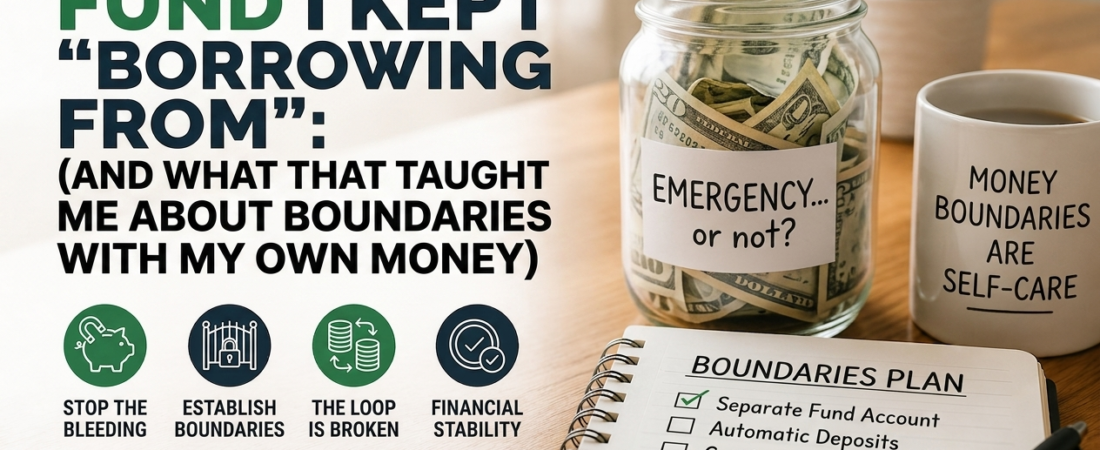
I built my emergency fund for the third time on a Tuesday in March, transferring the first $50 into a brand-new savings account with a name I’d given it specifically to feel different this time: “DO NOT TOUCH.” Very subtle. Very effective, apparently, for about four months.
Here’s the pattern, in case it sounds familiar: I’d build it up slowly, $30-50 at a time, feeling genuinely proud of the growing number. Then something would come up — not a real emergency, just a really good concert ticket, or a sale on something I’d wanted for a while, or a slightly-too-expensive birthday gift for a friend — and I’d think, reasonably, “I have the money right there. It’s sitting in an account. Why am I stressing about this $200 thing when I literally have it?”
And I’d “borrow” it. Always with a real intention to pay it back. Almost never actually paying it back, because paying yourself back isn’t a bill anyone sends you a reminder about. By the time an actual emergency showed up — a $400 car repair, as it happened — the account that was supposed to absorb it had quietly been spent down to $60 over the previous several months, one reasonable-sounding withdrawal at a time.
I rebuilt it. Used it again. Rebuilt it a third time. That third rebuild is when I finally sat down and asked myself what was actually going on — because clearly, “try to have more willpower next time” wasn’t working, no matter how many times I tried it.
Why “It’s My Money” Is Technically True and Practically Dangerous for Your Emergency Fund
Technically, you can spend your emergency fund on anything — it’s your money. But treating it as flexible spending defeats its entire purpose: when a real emergency arrives, the fund won’t be there. The fix isn’t willpower in the moment of temptation. It’s deciding, in advance, exactly what qualifies as an emergency — before you’re standing in front of a tempting non-emergency.
That first sentence is worth sitting with, because it’s the exact thought that derailed me three separate times.
“It’s My Money, I Can Do What I Want” — Why This Emergency Fund Logic Is a Trap
I want to be upfront about something before going further: this is your money, and at the end of the day, you get to decide what happens to it. Nobody — including me, including any financial guide you’ll ever read — has the authority to tell you that you’re not “allowed” to spend your own savings on a concert ticket, a vacation, or anything else. If you decide that’s what you want to do with money you saved, that’s a completely legitimate choice, and you don’t owe anyone an explanation for it.
But here’s why that technically-true statement is practically dangerous when it comes to an emergency fund specifically: the entire value of the fund comes from its narrow, restricted purpose. An emergency fund isn’t “savings” in the general sense — it’s insurance you wrote for yourself. And insurance only works if you don’t quietly cash it out every time something else looks appealing. The moment “it’s my money, I can do what I want” becomes the operating logic for the account, you haven’t just spent some savings — you’ve dismantled the actual function of the fund itself, even though the balance might look similar to what you started with after you “pay it back” eventually.
Here’s the part that took me three rebuilds to fully absorb: the danger isn’t in any single withdrawal. A single $150 “borrow” for a good reason isn’t going to ruin your financial life. The danger is that this logic, applied repeatedly, slowly converts an emergency fund into a second discretionary spending account with extra steps — one that happens to be empty exactly when you need it to be full, because every individual withdrawal felt reasonable in isolation. By the time the real emergency arrives, you’re not choosing between “spend the fund” and “don’t” — you’re discovering the fund was never actually there.
So the honest version of this isn’t “never touch it, no exceptions, you’re a bad person if you do.” It’s: know that this is the trade-off you’re making, on purpose, with full information — and decide deliberately whether that’s the choice you actually want to make, rather than sliding into it one reasonable-sounding withdrawal at a time without noticing the pattern.
The Real Reason We “Borrow” From Our Emergency Savings
Once I stopped beating myself up about it, I started noticing the actual mechanism behind every withdrawal. It wasn’t recklessness. It was almost always the same internal logic: “this isn’t really spending, because the money already exists. I’m just moving it.” Spending money you don’t have yet feels risky. Spending money that’s already sitting there, visible, accessible, feels like a completely different category of decision — even though, financially, it has the exact same effect on your safety net.
This is closely related to a concept called mental accounting — the tendency to treat money differently depending on where it’s stored or what label it has, even though a dollar is a dollar regardless of which account it sits in. An emergency fund with a generic name like “savings” gets treated, mentally, almost like spending money with a delay. An emergency fund with a specific, narrow purpose — genuinely categorized as “insurance,” not “savings” — gets treated very differently, because the mental category itself changes how available it feels.
Decide When to Use an Emergency Fund Before the Temptation
Here’s the single biggest shift that actually broke the cycle for me: I stopped trying to make the right decision in the moment of temptation, and started making the decision in advance, when I wasn’t tempted by anything specific.
This matters more than it sounds like it should. In the moment you’re looking at a concert ticket or a sale, your brain is actively generating reasons why this specific case is different, why it’s fine, why you’ll definitely pay it back. That’s not a character flaw — it’s just how in-the-moment decision-making works under the influence of immediate desire. Trying to apply discipline at that exact moment is fighting an uphill battle, every single time.
The fix is deciding the rule on a calm Tuesday with nothing tempting in front of you, writing it down somewhere you’ll actually see it again, and then treating that decision as already made — not up for re-litigation every time a new tempting situation appears. “Already decided” requires far less willpower than “deciding right now,” because you’re not negotiating with yourself in real time.
What Counts as an Emergency Fund Expense?
Here’s the definition I landed on, after the third rebuild, specific enough that it doesn’t leave room for in-the-moment negotiation:
- Qualifies: Unplanned, necessary, and time-sensitive. A car repair that affects your ability to get to work. A medical or dental bill. A necessary home repair (a broken water heater, not a kitchen remodel). A period of reduced or lost income.
- Doesn’t qualify: Planned but poorly budgeted for (a vacation, a holiday season, a wedding you knew about months in advance). Discretionary, even if it feels urgent in the moment (a sale, a limited-time offer, FOMO about an event). Anything you could delay 30 days without real consequence.
- The test that actually works: Ask “would I take on debt to handle this if I had zero savings?” If the honest answer is yes — you’d put it on a credit card without a second thought because it’s genuinely necessary — it qualifies. If the honest answer is “no, I’d just skip it or save up for it separately,” it doesn’t.
Writing this down once, in advance, removes almost all of the ambiguity that made room for “borrowing” in the first place. The concert ticket fails the test immediately. The car repair passes immediately. There’s no debate to have with yourself in the moment, because the debate already happened, days or weeks earlier, when nothing was on the line.
The Boundary That Finally Stuck
Beyond the written definition, two structural changes made the actual boundary hold in practice, not just on paper:
- I moved the account to a different bank entirely — not just a separate account at the same bank, but a different institution, with no debit card, requiring a 1-2 day transfer to access. The slight friction of “I’d have to actually initiate a transfer and wait” was enough to interrupt the impulsive version of “borrowing” almost completely.
- I renamed the account to describe its function, not its category. Not “Savings” — “Car Repair / Medical / Lost Income Fund.” Seeing that specific label every time I checked the balance made it mentally harder to justify using it for a concert ticket, because the account was visibly, explicitly not for that.
And the same milestone-based approach that made the first $1,000 feel achievable applied here too — the same goal gradient effect that made the first $1,000 feel reachable works just as well for rebuilding after a legitimate withdrawal. Each time I’ve used the fund for an actual emergency since then, rebuilding it hasn’t felt like starting over from a failure. It’s felt like the system working exactly as designed — because that’s exactly what it was doing.
FAQ: Emergency Fund Questions
Is it really that bad to use emergency savings for something fun once in a while?
It’s your money and your decision to make — there’s no rule against it. The practical risk is that “once in a while” tends to become a pattern without anyone deciding it should, and the fund’s protective function quietly erodes each time. If you do choose to use it this way, going in with that awareness, rather than discovering it later, is the more honest version of the choice.
What if I genuinely can’t tell if something is an emergency or not?
Use the debt test: would you take on credit card debt to handle this if you had zero savings at all? If yes, it’s a genuine emergency. If you’d more likely skip it, delay it, or save up separately, it’s not — even if it feels urgent in the moment.
Does it matter where I physically keep the emergency fund?
Yes, significantly. Keeping it in the same account as your everyday spending, or even a savings account at the same bank with instant transfer access, removes the friction that protects the fund from impulsive use. A separate bank with a short transfer delay adds just enough friction to interrupt impulse decisions without making genuine emergencies inaccessible.
What if I’ve already “borrowed” from mine multiple times — is it too late to fix this?
No — this is an extremely common pattern, not a sign of some unusual failure. The fix is the same regardless of how many times it’s happened before: write the definition down in advance, add structural friction (different bank, no debit card), and rebuild from wherever you currently are. Each rebuild gets easier once the structure is in place.
Should I feel guilty about using it for something that turned out not to be a real emergency?
Some reflection is useful, but ongoing guilt isn’t productive. The goal of writing the definition down isn’t to create a perfect track record — it’s to reduce how often this happens going forward. One mistake doesn’t undo the value of having attempted the system in the first place.