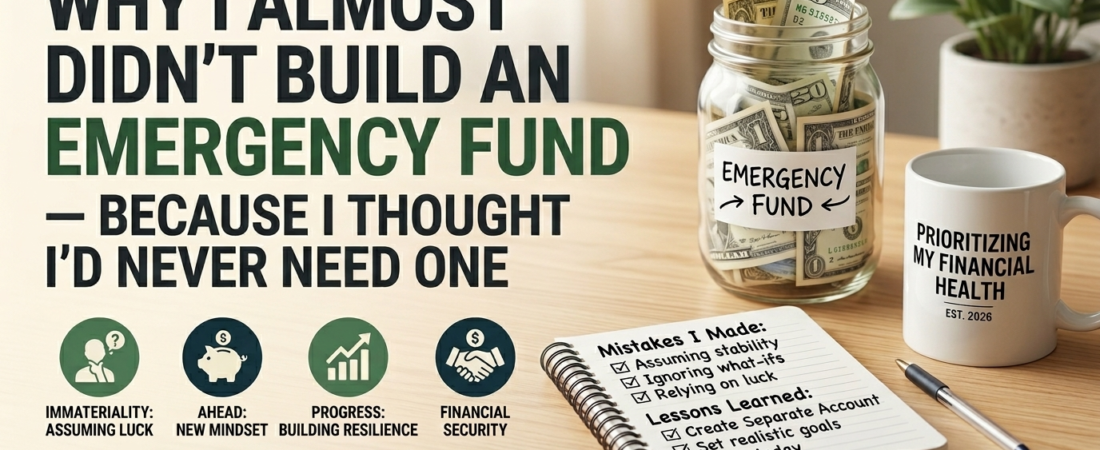
For a long time, I believed I didn’t need an emergency fund.
At 26, I had gone fourteen straight months without a single financial emergency. No unexpected car repairs, no medical bills, no job instability — just consistent income, predictable expenses, and a growing sense that I had finally figured out how money worked in my life.
So when someone asked if I had an emergency fund, my answer felt completely reasonable: “Not really, but I’m careful. I don’t think I need one right now.”
I wasn’t being irresponsible. I genuinely believed financial emergencies were something that happened to other people — not me.
Six weeks later, my appendix ruptured.
The surgery went well. Recovery took about three weeks. The bill, after insurance, was $2,400. I had $340 in savings.
That gap ended up on a credit card with 21% APR — and it took me 19 months to pay it off. But the real lesson wasn’t just financial. It was psychological:
Why was I so certain I would never need an emergency fund?
Why We Think Financial Emergencies Happen to Other People
There’s a reason so many people delay building an emergency fund, even when they know it’s important. It comes down to something called optimism bias.
Research shows that around 80% of people naturally believe they are less likely than others to experience negative events — including financial emergencies.
This isn’t stupidity or irresponsibility. It’s a built-in cognitive pattern.
The problem is that it quietly shapes behavior. If everything has been going well, your brain assumes it will continue that way — and suddenly, saving for emergencies feels unnecessary.
Most people would never say, “I’m immune to financial problems.” But their decisions often reflect exactly that belief.
Optimism Bias: The Hidden Reason Most People Don’t Build an Emergency Fund
Neuroscientist Tali Sharot describes optimism bias as one of the mind’s most powerful distortions — not because it makes us irrational, but because it operates below conscious awareness.
We instinctively compare ourselves to others and assume we’re less likely to experience bad outcomes. Statistically, this can’t be true for everyone — but it feels true based on our personal experience.
In personal finance, this creates a predictable cycle:
- Nothing bad happens for a while
- You feel increasingly secure
- You delay building an emergency fund
- The delay continues… until something finally goes wrong
The longer the streak lasts, the stronger the illusion becomes. But a streak isn’t stability — it’s just time without disruption.
Healthy Optimism vs. Financial Denial
It’s important to be clear: optimism itself is not the problem.
Optimistic people tend to have better health, greater resilience, and stronger long-term outcomes. The issue is when optimism turns into financial denial.
Here’s the key distinction:
- Healthy optimism: “Things will work out — and I’ll prepare anyway.”
- Financial denial: “Things will work out — so I don’t need to prepare.”
You can absolutely believe that things will be fine and still build an emergency fund. In fact, the most financially stable people tend to hold both beliefs at the same time.
The Moment My “Financial Stability” Fell Apart
The appendicitis didn’t just cost me money — it exposed a deeper problem.
I thought I had financial stability. What I actually had was a streak of things going well.
And a streak, by definition, ends.
What stayed with me wasn’t just the $2,400 bill — it was the realization that the situation would have been completely manageable if I had even $2,500 saved.
The emergency itself wasn’t a choice. But my preparation — or lack of it — absolutely was.
And even after going through that experience, something surprising happened: the optimism bias didn’t disappear.
It evolved into a new thought: “That happened once… but it probably won’t happen again.”
This is exactly the same pattern of avoidance I wrote about with emergency fund boundaries. The mind keeps finding new ways to delay preparation — even after learning the lesson the hard way.
How to Build an Emergency Fund Without Losing Your Optimism
You don’t need to become pessimistic to prepare for emergencies. You just need a system that works independently of your feelings.
Here’s what actually helps:
- Automate your savings. Set up an automatic transfer ($25–$50) on payday. This removes the need to “feel” like saving.
What the Data Says About Financial Emergencies
Optimism bias makes it easy to believe you’ll be the exception. But the data tells a different story:
- Most people face a financial emergency of $400 or more every 18–24 months
- Medical bills are one of the leading causes of personal debt, even with insurance
- Car repairs average $500–$600 and happen regularly
- About 1 in 5 workers experience job disruption each year
These aren’t worst-case scenarios — they’re normal life events.
The real question isn’t if something will happen. It’s when — and whether you’ll be ready.
FAQ: Emergency Fund and Optimism Bias
Is it normal to feel like I don’t need an emergency fund?
Yes. It’s a common effect of optimism bias. The goal isn’t to eliminate that feeling — it’s to build a system that works regardless of it.
If I’ve never had an emergency, do I still need a fund?
Yes. A long period without emergencies doesn’t reduce future risk — it often increases overconfidence.
I’m young and healthy — does this still apply to me?
Yes. Many financial emergencies — like job loss or car repairs — have nothing to do with age or health.
What’s a good starting amount?
$1,000 is a strong first milestone. It covers most small-to-medium emergencies and reduces reliance on credit.
How do I start if I don’t feel urgency?
Don’t rely on urgency. Automate a small amount and let the system do the work while your mindset catches up.