
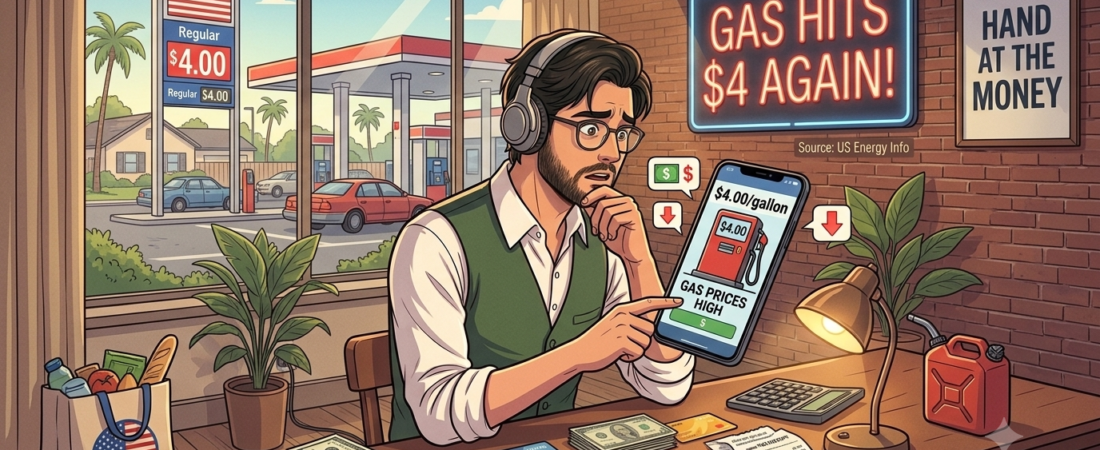
The national average gas price is $4.10 a gallon as of August 1, 2026 — the second time this year prices have crossed the $4 mark, following a spike, a drop below $4 in June, and a second spike in July. According to GasBuddy’s Patrick De Haan, this is the first year in US history gas has hit $4 in two separate surges — not in 2008, not in 2022, not ever.
- National average: $4.10/gallon, driven by the ongoing US-Iran conflict
- This is the second separate $4 spike in 2026 — a first in recorded history
- Prices vary enormously by state: $5.84 in California vs. $3.38 in Oklahoma
- Lower-income households are feeling the real budget squeeze right now; higher earners mostly aren’t yet
What’s Happening at the Pump
Gas prices spiked past $4 in the spring as the US-Iran conflict escalated, dropped back below $4 in mid-June after a temporary ceasefire briefly reopened oil shipping through the Persian Gulf, then shot back up past $4 again in July when that ceasefire fell apart. AAA’s national average now sits at $4.10, with the underlying cause unchanged: the Strait of Hormuz, which carries roughly a fifth of the world’s oil, remains disrupted by the fighting.
What makes this year unusual isn’t just the price — it’s the pattern. Gas has never before spiked above $4, dropped back down, and spiked again in the same year. It’s a sign of just how tied fuel prices have become to a war that keeps de-escalating and re-escalating.
Why $4 Gas Hits Harder Than It Should
Here’s something worth sitting with: for most households, gas is a smaller line item than rent, groceries, or insurance. But it’s the price you see every single day, posted in giant numbers on a sign you drive past. That visibility does something to how “bad” the economy feels, separate from what the math actually says about your budget. A $30 jump in your monthly gas bill can feel more alarming than a $30 jump somewhere else you don’t watch as closely — even though your wallet doesn’t know the difference.
That’s not a reason to ignore it. It’s a reason to be intentional about it — react to what it’s actually costing you, not to how loud the number feels.
What This Means for Your Budget
The honest math: at $4.10 a gallon, filling a 12-gallon tank costs about $49, up from roughly $36 a gallon at $3. If you fill up weekly, that’s an extra $50-plus a month compared to lower-price stretches — real money, but rarely the thing that breaks a budget on its own. Where it gets serious is for lower-income households and anyone driving long distances for work, where gas eats a bigger share of take-home pay and there’s less room to absorb it.
If you’re feeling the pinch, small route and errand-combining changes add up faster than people expect, and it’s worth checking whether your state is one of the cheaper ones nearby if you’re near a border. But the bigger move is not letting a visible, daily price spike bleed into decisions about your whole budget — one rising cost doesn’t mean every plan you’ve made is suddenly wrong.