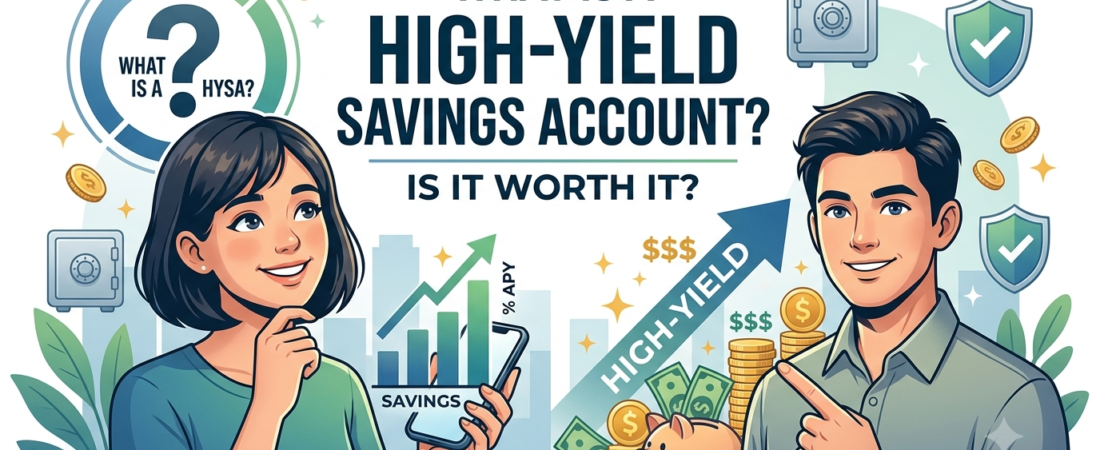
What Is a High-Yield Savings Account — And Is It Actually Worth It?
If your savings are sitting in a traditional bank account earning almost nothing, you’re leaving real money on the table every single month. A high-yield savings account (HYSA) can pay you 10 times more interest — sometimes more — with zero additional risk. But it’s not the right move for every situation. Here’s everything you need to know to decide if one makes sense for you right now.
What Is a High-Yield Savings Account?
A high-yield savings account is a regular savings account that pays a significantly higher interest rate than what you’d get at a traditional bank. Your money is just as safe, just as accessible, and just as FDIC-insured — it just earns a lot more while it sits there. The main difference is the interest rate, expressed as APY (Annual Percentage Yield — the total amount you earn in a year, including the effect of compounding). Most traditional bank savings accounts pay around 0.01% to 0.40% APY. The best HYSAs in June 2026 are paying between 4.00% and 5.00% APY.
How Much More Money Does a HYSA Actually Earn?
Let’s skip the percentages for a moment and look at what this means in actual dollars — because that’s what matters.
Say you have $5,000 in savings sitting in an account for one full year:
- Traditional savings account at 0.38% APY (the current national average, per FDIC): you earn about $19
- High-yield savings account at 4.20% APY (a competitive rate available in June 2026): you earn about $210
That’s $191 more per year — for doing nothing differently except choosing the right account. On $10,000, that gap grows to roughly $382. On $20,000, you’re looking at $764 in extra interest annually, just for switching banks.
The math gets even more favorable over multiple years because of compound interest — you earn interest on your interest. Most HYSAs compound daily and pay monthly, so your balance grows a little faster than a simple annual calculation would suggest.
What Does APY Mean — In Plain English?
APY (Annual Percentage Yield) is the total percentage your money earns over one year, already accounting for how often the interest compounds. It’s the number you should always compare when shopping for savings accounts — not the “interest rate,” which doesn’t include compounding.
Here’s a simple way to think about it: if your HYSA has a 4.00% APY and you deposit $1,000, you’ll have approximately $1,040 after one year. If you deposit $5,000 at the same APY, you’ll have about $5,200. That’s it. The math is straightforward — and the bank does it all for you automatically.
Is My Money Safe in a High-Yield Savings Account?
Yes — and this is one of the most important things to understand. The vast majority of HYSAs are offered by FDIC-insured banks (or NCUA-insured credit unions). FDIC insurance — provided by the Federal Deposit Insurance Corporation, a U.S. government agency — protects your deposits up to $250,000 per bank, per depositor. If the bank fails, you get your money back, up to that limit. This is the same protection you have at Chase, Bank of America, or any big traditional bank.
Many HYSAs are offered by online-only banks — banks that don’t have physical branches. That sometimes makes people nervous, but it shouldn’t. Online banks like Ally, Marcus by Goldman Sachs, and Capital One 360 are just as regulated and FDIC-insured as brick-and-mortar banks. They simply have lower overhead costs (no branches to maintain), which is why they can pass along higher rates to you.
One thing to always verify: before opening any account, confirm it is FDIC or NCUA insured. You can verify any bank at FDIC.gov. Legitimate HYSAs will display their FDIC membership clearly.
The Real Downsides of High-Yield Savings Accounts
A HYSA is a great tool — but it’s not perfect. Here’s what the bank brochures don’t always tell you up front.
1. Rates Are Variable — They Can Drop Without Warning
The APY on a HYSA is not locked in. Banks can — and do — adjust rates based on what the Federal Reserve (the US central bank) does with interest rates. When the Fed cuts rates, HYSA rates tend to follow. This happened in late 2024 and into 2025: the Fed made several rate cuts, and many banks lowered their HYSA rates in response. Rates are still very competitive in June 2026 (4.00%–5.00% APY at top banks), but they could decrease further.
This is why a HYSA is ideal for short-to-medium-term savings goals — not a replacement for long-term investing. For money you plan to keep invested for 5, 10, or 20+ years, the stock market has historically outperformed savings accounts significantly. A diversified index fund has returned around 10% per year on average historically, compared to 4–5% on a HYSA right now.
2. The Interest You Earn Is Taxable
The interest earned in a HYSA is taxed as ordinary income — just like your paycheck. At the end of the year, your bank will send you a Form 1099-INT showing how much interest you earned, and you’ll owe federal income tax on that amount.
But here’s the perspective check: taxes don’t eliminate the benefit — they just reduce it slightly. Going back to our earlier example: if you earn $210 in interest on $5,000 and you’re in the 22% federal tax bracket, you’d owe about $46 in taxes on that interest. You still net $164 more than you would have earned in a traditional savings account. The HYSA is still very much worth it.
3. Transfers Can Take 1–3 Business Days
Most online HYSAs are linked to your checking account at another bank. Moving money between them typically takes 1–3 business days. This isn’t a problem for an emergency fund (you usually have a day or two to sort things out) — but it’s worth knowing. If you need instant access to cash, make sure you also have a checking account or a small buffer at your main bank.
4. Some Accounts Have Strings Attached
A few HYSAs advertise impressive APYs but require you to meet conditions to earn that rate — like maintaining a minimum balance, setting up direct deposit, or making a certain number of monthly transactions. Always read the fine print before opening an account. The best beginner-friendly HYSAs have no minimum balance, no monthly fees, and no hoops to jump through.
When Is a High-Yield Savings Account the Right Choice?
A HYSA is the right place for money that needs to be:
- Safe — you can’t afford to lose it
- Accessible — you might need it within the next 1–3 years
- Growing — but not at the risk of the stock market
The best uses for a HYSA are:
- Your emergency fund — the 3–6 months of living expenses you keep on hand for job loss, medical bills, or unexpected repairs. This money should never be in the stock market, and it should earn as much as possible while you wait to (hopefully) never need it.
- Short-term savings goals — a car down payment in 18 months, a vacation fund, a security deposit for an apartment, or a wedding fund.
- Your “opportunity fund” — cash you’re saving to deploy for a business idea, a real estate opportunity, or to buy a home within the next few years.
When Is a HYSA the Wrong Choice?
A HYSA is not the right home for money you won’t need for 5+ years. If you’re saving for retirement or building long-term wealth, money sitting in a 4% HYSA while inflation runs at 2–3% gives you a real return of only 1–2% — and historically, the stock market delivers much more over long periods.
Think of it this way: your emergency fund belongs in a HYSA. Your retirement savings belong in a Roth IRA or 401(k), invested in low-cost index funds. These two tools serve completely different purposes — and confusing them is one of the most common beginner money mistakes.
Also, if you’re carrying high-interest debt — credit card balances at 22–28% APR — paying that down first is a far better financial move than opening a 4% HYSA. You can’t out-earn a 25% interest rate with a savings account.
Best High-Yield Savings Accounts to Consider in 2026
Rates change frequently, so always verify the current APY before opening an account. As of June 2026, these are consistently among the top options for beginners — all FDIC-insured, no monthly fees, and no minimum balance requirements:
- Marcus by Goldman Sachs — Consistently competitive APY, no minimum balance, no fees, straightforward interface. One of the most trusted names in online savings.
- Ally Bank Online Savings Account — No minimums, no fees, excellent mobile app, and buckets feature that lets you organize savings goals within one account (great for tracking your emergency fund separately from your vacation fund).
- Capital One 360 Performance Savings — Slightly lower APY than some competitors but backed by a major bank with physical locations if you ever want in-person help. Currently around 3.10% APY.
- Vio Bank — Consistently among the top rates with minimal requirements. Currently 4.03% APY with no monthly fee.
- Varo Bank — Up to 5.00% APY, but only on balances up to $5,000 and requires qualifying direct deposits. Best if you meet those conditions.
Important note: rates listed here reflect June 2026 and will change over time. Before opening an account, check NerdWallet’s savings account comparison tool for the most current rates — they update it daily.
How to Open a High-Yield Savings Account (Step by Step)
- Choose your bank — pick one from the list above, or compare current rates at NerdWallet or Bankrate. Look for: no monthly fees, no minimum balance, FDIC-insured, and an APY clearly above 3.50% in the current environment.
- Go to the bank’s website directly — always navigate directly, don’t click on ads or sponsored links. Type the URL yourself.
- Apply online — you’ll need your Social Security number, a government-issued ID, your address, and your date of birth. The process takes about 10 minutes.
- Link your checking account — to transfer money in and out. You’ll enter your checking account’s routing and account numbers (found on a check or in your bank’s app).
- Make your opening deposit — most HYSAs have no minimum, but even $100–$500 gets you started and earning interest immediately.
- Set up automatic transfers — if you’re building an emergency fund, automate a fixed amount each payday to move directly to your HYSA. Even $50–$100/month adds up quickly.
Frequently Asked Questions
Is a high-yield savings account better than a CD?
A CD (Certificate of Deposit) locks your money for a fixed period — 6 months, 1 year, 2 years — and pays a fixed rate. A HYSA keeps your money accessible anytime but has a variable rate. For an emergency fund, a HYSA wins because flexibility matters more. For money you definitely won’t need for 12–24 months, a CD can sometimes offer a slightly higher rate. Compare both before deciding.
How much should I keep in a high-yield savings account?
At a minimum, your emergency fund — ideally 3–6 months of your essential monthly expenses. Beyond that, keep any money earmarked for a specific goal within 1–3 years. Money you won’t need for 5+ years should generally be invested, not sitting in a savings account.
Can I lose money in a high-yield savings account?
No — as long as the bank is FDIC-insured and your balance is under $250,000. Your principal is protected, and the interest is guaranteed at whatever rate the bank currently offers. The only “loss” is if inflation outpaces your APY, which erodes your purchasing power slightly — but your dollar amount never goes down.
Do I need good credit to open a HYSA?
No. High-yield savings accounts don’t require a credit check. You need a valid ID, a Social Security number, and a linked bank account to fund the deposit. That’s it.
The Bottom Line: Is a High-Yield Savings Account Worth It?
Yes — with one condition: you have to use it for the right purpose. If you’re parking an emergency fund, saving for a near-term goal, or simply holding cash you don’t want to invest yet, a HYSA is one of the smartest, easiest financial moves available to any American right now. Earning 4%+ instead of 0.38% requires zero extra risk and about 10 minutes to set up.
It’s not a wealth-building tool on its own. It won’t replace investing. But as a home for your safe, accessible cash — it beats a traditional savings account in every single way.
Next step: If you don’t have an emergency fund yet, your HYSA’s first job is to hold one. Find out exactly how much you should save and how long it realistically takes to build it from scratch.