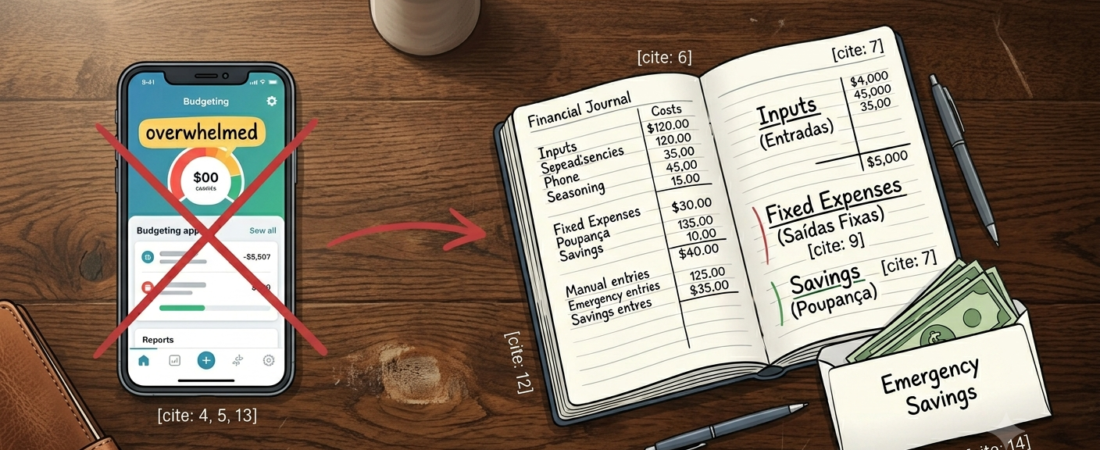
I opened the app on a Tuesday night, mostly out of guilt. It had been — I checked — 23 days since I’d last looked at it. And there it was: 47 uncategorized transactions, sitting in a little red bubble, just waiting for me.
I remember staring at that number and feeling something close to dread. Not because $47 charges were going to reveal some financial disaster. But because categorizing them felt like homework I’d been avoiding for three weeks, and now I had three weeks’ worth all at once. “Was this a grocery run or a Target run? Is this restaurant ‘dining out’ or ‘entertainment’? What even *was* this $34 charge from two Tuesdays ago?”
I closed the app. I didn’t open it again for another month. And then, eventually, I deleted it — not in some dramatic moment, just quietly, the way you delete an app you haven’t opened in a while and don’t expect to miss.
That was my third budgeting app. I want to talk about why that kept happening — and what I do now instead, which is almost embarrassingly simple.
Why Budgeting Apps Have Such High Dropout Rates (It’s Not You)
Most budgeting apps fail not because of bad design, but because they assume tracking changes behavior. In reality, seeing detailed spending data doesn’t automatically lead to spending less — it just creates a sense of awareness without action. Add decision fatigue from too many categories, and most people quietly stop opening the app within weeks.
If that’s been your experience — three apps, three quiet deletions, no dramatic failure, just fading interest — you’re not the exception. You’re basically the rule.
The Illusion of Control: Why Seeing Your Spending Doesn’t Change It
Here’s the thing that took me way too long to figure out: looking at a pie chart that says “32% of your spending was on Dining” doesn’t make you spend less on dining. It just means you now *know* you spent a lot on dining — which, if anything, can make you feel worse without actually changing the next decision.
This is sometimes called the illusion of control — the sense that because you can *see* the data, you must be *managing* it. But knowing and doing are completely different things. Knowing you spent $240 on delivery this month doesn’t make the $240 next month not happen. It just means that, this time, you’ll feel a little guilty about it while it’s happening.
Budgeting apps are very good at the “seeing” part. They’re almost entirely silent on the “doing” part — which is the part that actually matters.
The Shame Spiral, App Edition: How “I’m Behind” Becomes “I’m Done”
That 47-transaction moment wasn’t really about the transactions. It was about what those 47 transactions *represented*: proof that I’d “fallen behind” on something I was supposed to be doing.
This is the same shame loop I wrote about with savings, just wearing a different outfit. The pattern goes: you miss a few days of logging → you feel a little behind → opening the app now means “catching up,” which feels like work → you avoid it a little longer → now you’re more behind → the gap between “where the app thinks you are” and “where you actually are” grows → eventually, the app stops feeling like a tool and starts feeling like an unfinished chore with your name on it.
At that point, deleting the app doesn’t feel like giving up. It feels like relief. And that relief is a huge clue — it tells you the tool was creating more stress than value, which is the opposite of what a budgeting tool is supposed to do.
What I Tried (and Quietly Abandoned) Before Finding Something That Stuck
In the interest of full honesty, here’s the lineup of things I tried, roughly in order:
- A popular all-in-one budgeting app — great at linking accounts, terrible at categorizing correctly. I spent more time fixing miscategorized transactions than I spent actually thinking about my money.
- A zero-based budgeting app — genuinely powerful if you stick with it, but the learning curve and weekly maintenance were more than I had bandwidth for at the time. I lasted about five weeks.
- A spreadsheet template I found online — beautiful, color-coded, way too many tabs. I filled it out once, fully, and never opened it again. It was designed for a version of my life that involved more free time than I actually had.
- A “just don’t look” approach — which, to be clear, isn’t a system. It’s the absence of one. But I want to include it because I think a lot of people land here after the apps fail, and it’s worth naming as its own (unhelpful) category.
What all of these had in common: they required *ongoing effort* to maintain, and the moment life got busy — which is always, eventually — the effort stopped, and so did the system.
The Stupidly Simple System That Actually Worked
Here’s what I actually do now, and I want to be upfront that it sounds almost too basic to write an article about. But it’s the only thing that’s lasted more than two months.
Step 1: One number, once a week. Every Sunday night, I check one number: how much is in my checking account. That’s it. No categorizing. No “where did this go.” Just the number.
Step 2: Three buckets, decided in advance. At the start of the month, I roughly split my paycheck into three buckets — bills (the fixed stuff), flexible (groceries, gas, the stuff that varies), and “leftover” (savings + whatever’s left). No subcategories. No “dining vs. entertainment vs. coffee.” Just three.
Step 3: The flexible bucket lives in a separate account. This is the part that actually changed things. The “flexible” amount gets moved to a second checking account at the start of the month. Whatever’s in there is what I have for everything that isn’t a fixed bill. When it’s gone, it’s gone — no app needs to tell me that, the account balance tells me directly.
That’s the whole system. One number, checked weekly, with money pre-sorted into a place where the balance itself does the “tracking” for me. No categorizing 47 transactions. No red notification bubble. No app to feel behind on.
Who Should (and Shouldn’t) Use a Budgeting App
I don’t want to overcorrect here — apps genuinely work well for some people, and it’s worth being honest about who:
- Apps tend to work well if: you enjoy detail and find tracking satisfying rather than draining, you have complex finances (multiple income streams, business + personal, investments) where categorization adds real value, or you’re working toward a specific goal (like debt payoff) where seeing the breakdown motivates you.
- The simple system tends to work better if: you’ve already tried 2+ apps and quietly stopped using them, your income and expenses are relatively straightforward, or just opening a finance app makes you feel a flicker of dread before you even tap it.
There’s no prize for using the more “sophisticated” system. The best system is the one that’s still running in three months.
FAQ: For Anyone Who’s Deleted a Budgeting App More Than Once
Doesn’t the “three buckets” system lose accuracy compared to a detailed app?
Yes, technically — but accuracy you don’t maintain isn’t actually accurate. A simple system you check every week beats a detailed one you check every three weeks, every time.
What if my flexible spending varies a lot month to month?
Start with your average from the last 2-3 months as a rough estimate, and adjust slightly each month based on what’s coming up (a birthday, a car appointment). It doesn’t need to be precise — it needs to be a number you can check against.
Is it bad that I don’t know exactly where my money goes anymore?
Not necessarily — for many people, knowing the category breakdown didn’t actually change their spending anyway. If your flexible account balance is healthy at the end of the month, the “where” matters less than the “how much is left.”
What happens when I go over my flexible amount one month?
That’s normal, and it’s worth building room for it rather than treating it as a failure — a system that leaves room for being human tends to last a lot longer than one that assumes perfect compliance every month.
What if I’m avoiding even checking my account balance, app or no app?
That’s worth addressing on its own — it’s the same avoidance pattern that keeps people from checking their bank balance at all, regardless of what system they’re using, and it usually needs to be tackled before any budgeting system (simple or complex) can stick.