Every January for about four years in a row, I made a budget. Not a casual “I should probably spend less” intention — an actual budget, with categories and numbers and, one year, a color-coded spreadsheet I was genuinely proud of. I’d sit down in the first week of the year, feel extremely responsible for about 45 minutes, and then watch the whole thing quietly fall apart by the second or third week of February.
The frustrating part wasn’t that I failed. It was that I already knew what I was supposed to do. I knew I should save. I knew I should track my spending. I knew the $6 coffee wasn’t the problem but the $400 month of eating out probably was. I had the information. I had the intention. I had the spreadsheet, for crying out loud.
And still, February.
It took me an embarrassingly long time to figure out that the problem wasn’t that I needed more information, more motivation, or a better spreadsheet. The problem was that I was trying to solve a design problem with willpower — and willpower, it turns out, is just about the worst tool for that particular job.
The Behavior Gap: When Knowing and Doing Live in Different Zip Codes
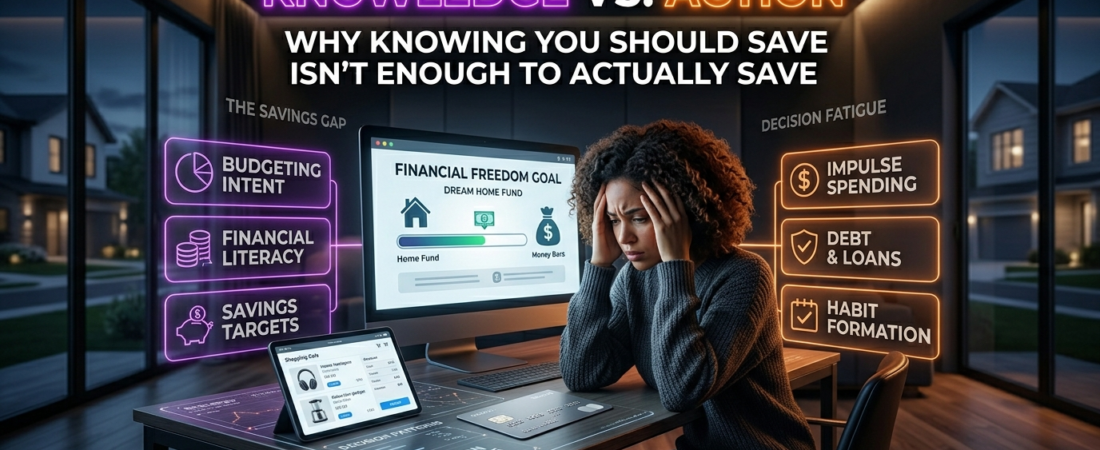
The gap between knowing you should save and actually saving is called the “behavior gap” — and it’s not a willpower problem. It’s a design problem. Your brain is wired to prioritize immediate rewards over future ones, which makes saving feel optional in the moment even when it feels urgent in theory. The fix is changing your environment, not your effort.
Financial planner Carl Richards spent years watching his clients — smart, well-intentioned people — make the same financial mistakes over and over. Not because they didn’t understand what they should do. Because something kept getting in the way between understanding and doing. He named that something “the behavior gap” — the distance between what we know we should do and what we actually do.
The behavior gap isn’t a personal failing. It’s a feature of human psychology that shows up in virtually everyone, regardless of income, education, or how many finance books they’ve read. Knowing it has a name — and understanding why it exists — is genuinely the first step to working around it instead of blaming yourself for it.
Your Brain Was Not Built for “Later”: The Present Bias Problem
Here’s the core of the problem: your brain assigns significantly more value to things that happen now than to things that happen in the future — even when the future thing is objectively more important. This is called “present bias,” and it’s not a personality flaw. It’s a feature of how human brains evolved.
For most of human history, saving resources for a distant future was a genuinely bad strategy. The future was uncertain, food spoiled, and the immediate environment was full of real threats that needed real responses right now. The brains that survived were the ones that responded decisively to present conditions, not the ones that optimized carefully for six months from now.
That worked great on the savannah. It works terribly for building a savings account in 2026.
Present bias is why “I’ll start saving next month” is a promise your brain makes in complete sincerity — and breaks in complete sincerity. In the moment of making it, “next month” feels close enough to be real. When next month arrives, it faces competition from actual present-moment wants and needs, and the future (which is now the month after next) feels just as far away as it always did.
This is also why “just be more disciplined” is such ineffective advice. Discipline requires overriding the present-bias instinct through conscious effort, every single time a decision arises. That’s exhausting. It works for a while, and then it stops working, usually right around the second week of February.
Why Willpower Is the Wrong Tool for a Structural Problem
Imagine you’re trying to eat less sugar. You could white-knuckle your way through every meal, using willpower to resist the dessert menu. Or you could just not put dessert in the house. Same outcome, infinitely less effort — because you changed the structure of the environment instead of fighting your instincts inside it.
Financial behavior works the same way. If saving requires a conscious decision every single time — “should I transfer some money this month?” — it’s competing with present-bias every single time, and present-bias has a home-field advantage. But if saving is automatic — the transfer happens before you see the money, the account is separate so the balance isn’t visible — it removes the decision entirely. You’re not resisting temptation. You’re just not encountering it.
This is the insight that changed everything for me: the problem wasn’t that I lacked discipline. The problem was that my entire system was built around requiring discipline, repeatedly, indefinitely, without any structural support. I was fighting the same battle every month and wondering why the results kept being the same.
Willpower is a resource, and like all resources, it depletes. You use it on decisions at work, on difficult conversations, on navigating a stressful commute. By the time you get to “should I transfer money to savings this month?”, it may genuinely have nothing left to give. And that’s not weakness — that’s math.
The Environment Design Fix: How to Make Saving the Path of Least Resistance
Environment design is the practice of structuring your surroundings so that the behavior you want is the easiest path, not the hardest one. Applied to saving money, it looks like this:
- Automate before you see the money. Set up a transfer that moves money to savings on payday — before you’ve had a chance to spend it, before it “feels” available, before present-bias has registered it as a resource to use. You can’t spend what you never saw arrive.
- Use a separate account you don’t check daily. The more visible money is, the more it feels available. A savings account at a different bank, without a debit card attached, with no balance showing in your primary banking app — that’s friction, and friction is your friend here. Out of sight, genuinely harder to access, means present-bias doesn’t register it as a target.
- Make the “bad” choice slightly harder. This sounds counterintuitive, but adding one small step between you and impulsive spending — deleting a saved credit card from a shopping site, leaving your card at home on days you know you’ll be near stores you impulse-buy in — reduces the number of times present-bias wins without requiring you to be “stronger.”
- Give the savings account a name. This sounds almost too small to mention, but research on “labeled accounts” consistently shows that money given a specific name (even just “car fund” or “emergency”) is significantly less likely to be spent than money sitting in a generic “savings” account. Naming it makes the future goal feel present.
None of these require you to be a different person. They just change what the path of least resistance looks like — and that’s exactly why starting absurdly small is the actual answer. The goal isn’t a perfect system from day one. It’s one small structure that runs without requiring decisions.
From Knowing to Doing: The Three Smallest Possible First Steps
If the behavior gap is a design problem, the fix is design — not motivation. Here are the three smallest structural changes that close the gap faster than any amount of renewed intention:
- Set up one automatic transfer for next payday. Not a big one. Not a “meaningful” one. Whatever amount is so small it doesn’t feel worth arguing about — $10, $25, $5. The amount is genuinely less important than the structure. You’re building the pipe, not filling it.
- Identify the one decision point where you reliably lose. For most people, it’s a specific moment: the grocery store checkout, the online cart at 11pm, the month’s first weekend. That moment is where the behavior gap lives for you specifically. Name it. The same cycle I described with budgets that break under pressure almost always has a specific trigger point — and once you see it, you can design around it.
- Remove one piece of friction from saving and add one piece of friction to spending. Unlink a card from a shopping site. Move the savings transfer to happen automatically. These two moves — one on each side — do more structural work than a month of renewed motivation.
Why This Time Can Actually Be Different (Without Trying Harder)
I want to be careful here, because “this time will be different” is something a lot of us have said before, to ourselves, in January, with a color-coded spreadsheet in front of us. So let me be specific about what I mean.
This time can be different not because you’re going to try harder — but because you’re going to try differently. The previous attempts failed because they were built around willpower. This one is built around structure. Those are different things, and they fail differently. A willpower-based system fails the moment you’re tired, stressed, or distracted. A structure-based system keeps running in the background regardless of how you’re feeling on a Thursday afternoon.
That’s a real difference. And the shame that lives inside this gap — the “I’ve tried this before and failed” feeling that makes starting again feel pointless — is worth addressing directly, because it’s often the biggest obstacle between knowing and doing. Not the system. Not the numbers. The feeling that it’s not worth trying again because it hasn’t worked before.
It hasn’t worked before because the design was wrong. That’s fixable. You are not.
FAQ: For Anyone Who’s Broken the Same Promise to Themselves More Than Twice
Is the behavior gap the same as being bad with money?
No — the behavior gap is a universal feature of human psychology that affects everyone, regardless of income or financial knowledge. Being “bad with money” implies a personal flaw. The behavior gap describes a predictable mismatch between how our brains work and what modern financial decisions require of them. Different problem, different solution.
Does automating savings really make that much of a difference?
Yes — consistently, across research. Automatic enrollment in workplace retirement plans dramatically increases participation rates compared to opt-in systems with identical options. The structure of the decision matters as much as the decision itself. When saving is the default, people save. When spending is the default, people spend.
What if I’ve automated savings before and just turned it off when money got tight?
That’s actually useful information — it tells you the automation amount was set too high. An automation you cancel under pressure was competing with real needs. Drop the amount to something that doesn’t feel worth cancelling, even in a tight month. $5 that runs consistently beats $100 that gets turned off in month two.
How long does it take to close the behavior gap?
The structural changes (automation, separate accounts) take about 20 minutes to set up and start working immediately. The psychological shift — actually feeling like someone who saves, rather than someone who’s trying to save — typically takes two to three months of consistent structure before it feels natural rather than effortful.
What if I know all of this already and still can’t make myself do it?
Then the gap isn’t informational — it’s emotional. Sometimes the block between knowing and doing is rooted in a deeper belief about whether you’re the kind of person who can manage money, or whether it’s worth trying again after previous failures. That’s worth sitting with honestly, because no system design fixes a belief that the system is pointless.